


Pensions are in somewhat of a marketing crisis, with many viewing ‘pensions’ as a dirty word.
In fairness, the word isn’t particularly exciting and tends to conjure up images of withering away in later life, too old to enjoy your hard-earned money.
However, do not be fooled by the dull façade. Pensions are Wealth Creation Machines.
For the majority of our clients, pensions are the single most important wealth creation tool at their disposal.
They’re not just a retirement product, they’re the cornerstone of effective wealth planning. For high-earning professionals, business owners, and everyone inbetween, pensions represent one of the most tax-efficient and flexible tools to grow and protect assets over the long term.
Yet, despite their importance, they remain widely misunderstood.
In this guide, we clarify the core benefits, dispel common misconceptions, and illustrate how pensions can support a broader financial plan that aligns with your values, lifestyle, and legacy.
What is a Pension?
At its core, a pension is a tax-deferred investment account designed to provide income in retirement.
There are two main pension types:
- Defined Benefit (DB): Provides a guaranteed income in retirement, based on salary and service. These are now rare and mostly offered in the public sector (also known as, ‘Final Salary’ or ‘Career Average (CARE)’).
- Defined Contribution (DC): A ‘pot-based’ system where the value is not guaranteed, and is instead determined by how much you contribute and how the chosen investments perform.
The rest of this article will focus on defined contributions pensions.
The two main DC pensions you’ll come across are:
- Workplace pensions: Set up by your employer and usually include employer contributions (more on this later).
- Personal pensions (inc. SIPPs): Established by individuals for personal retirement savings.
These pensions come with some great benefits:
- Tax relief on contributions.
- Free money from your employer.
- Flexible income options at retirement.
- Investments grow in a tax-sheltered environment.
Let’s look into each one in more detail.
Tax Relief
Personal pension contributions attract tax relief at your marginal rate:
- Basic rate: 20%
- Higher rate: 40%
- Additional rate: 45%
What does this mean? It means the government adds money to your pension, which is referred to as ‘grossing up’ your contribution.
Here’s how it works on an £80 contribution (to get £100 into your pension):
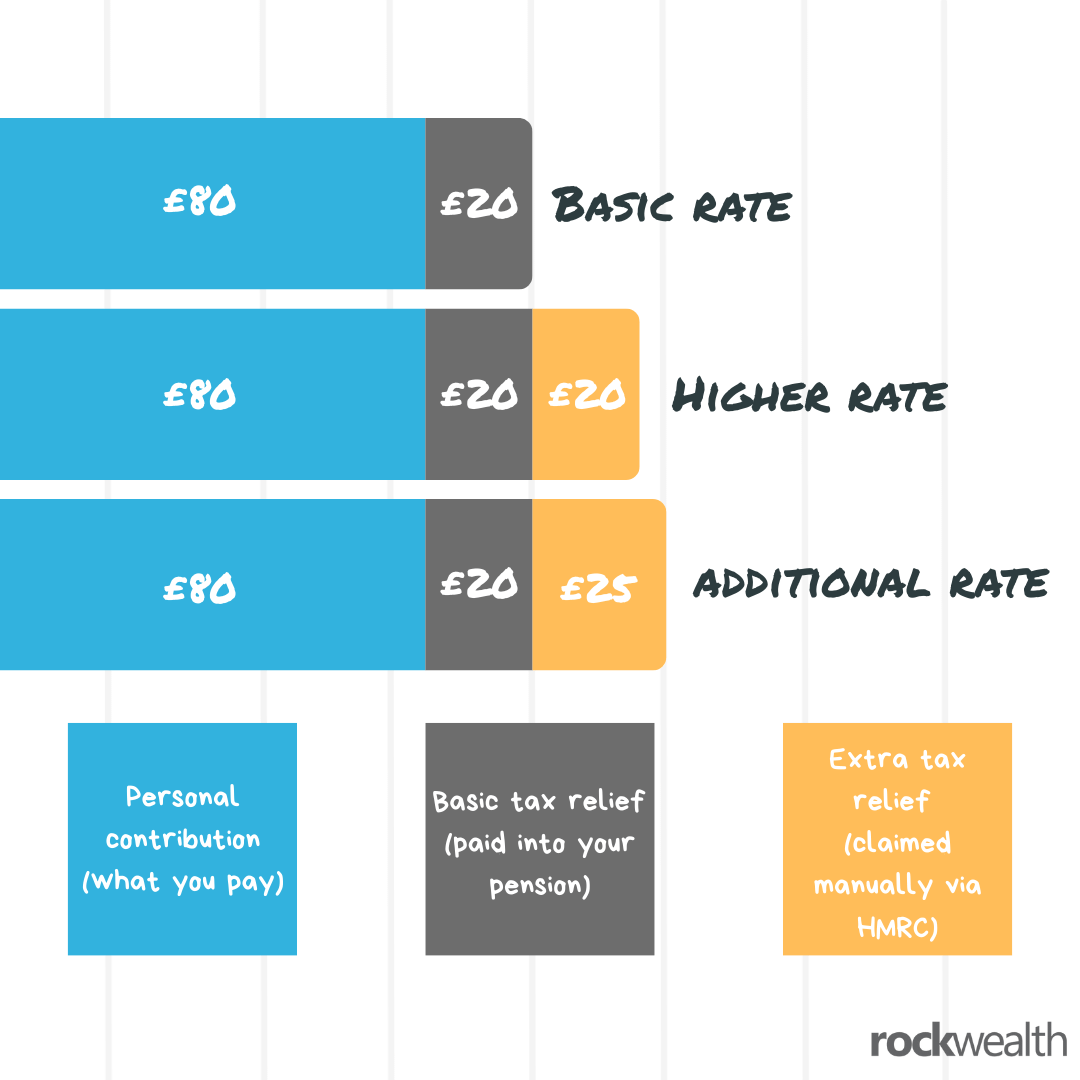
So, you only have to pay £80 of your own money to get £100 into your Wealth Creation Machine, as the government pays the other £20. Higher and additional rate taxpayers can then reclaim a further 20-25%*, via self-assessment, which is paid via one of the following:
- A tax rebate.
- A change in your tax code.
- A reduction in your tax bill.
The result of which is the net cost to get £100 into their pensions is:
Higher rate: £60
Additional rate: £55
*You have to claim this yourself, be sure not to miss out on the extra tax relief.
For limited company directors: employer contributions are an effective way to extract profits from your business without triggering personal tax liabilities. Unlike salary or dividends, pension contributions are deductible against corporation tax and are not subject to National Insurance.
Refer to our article on[financial planning for business owners] for more detail.
Free Money: Employer Contributions
Some say a free lunch doesn’t exist… but they haven’t heard about employer pension contributions.
Many employees overlook the real value of their workplace pension and employer contributions. These are often structured as a percentage of salary and can sometimes be increased through matching schemes (if offered by the employer)..
In some cases, salary exchange schemes can further enhance efficiency by reducing employer NI contributions, some of which can also be rebated into the pension.
Lets look at a £2,000 per month salary, using basic salary as pensionable earnings, it may look like this:
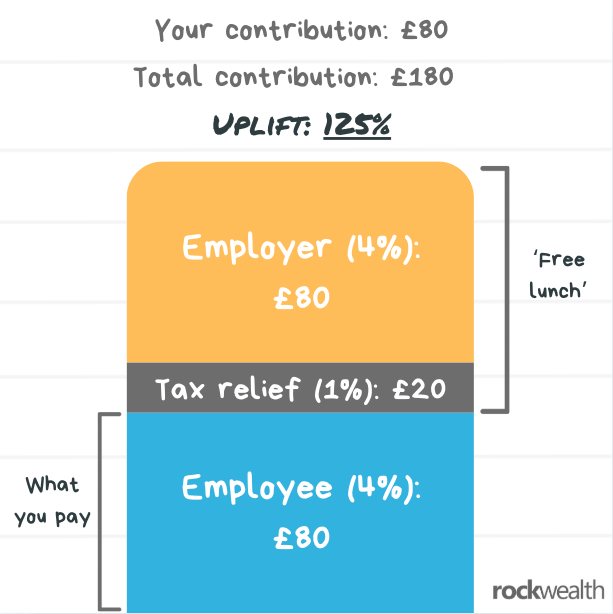
You’ve more than doubled your money and you haven’t even invested it yet!
As if the above benefits aren’t enough, pension contributions also reduce your taxable income, which means they can be used for the following:
- Avoiding/reducing exposure to the 62% tax trap.
- Avoiding/reducing exposure to the High Income Child Benefit Charge.
Tax Sheltered Growth and Compound Returns
Like ISAs, investments inside a pension are free from income tax and capital gains tax. This results in more efficient compounding over time compared with unwrapped investments:
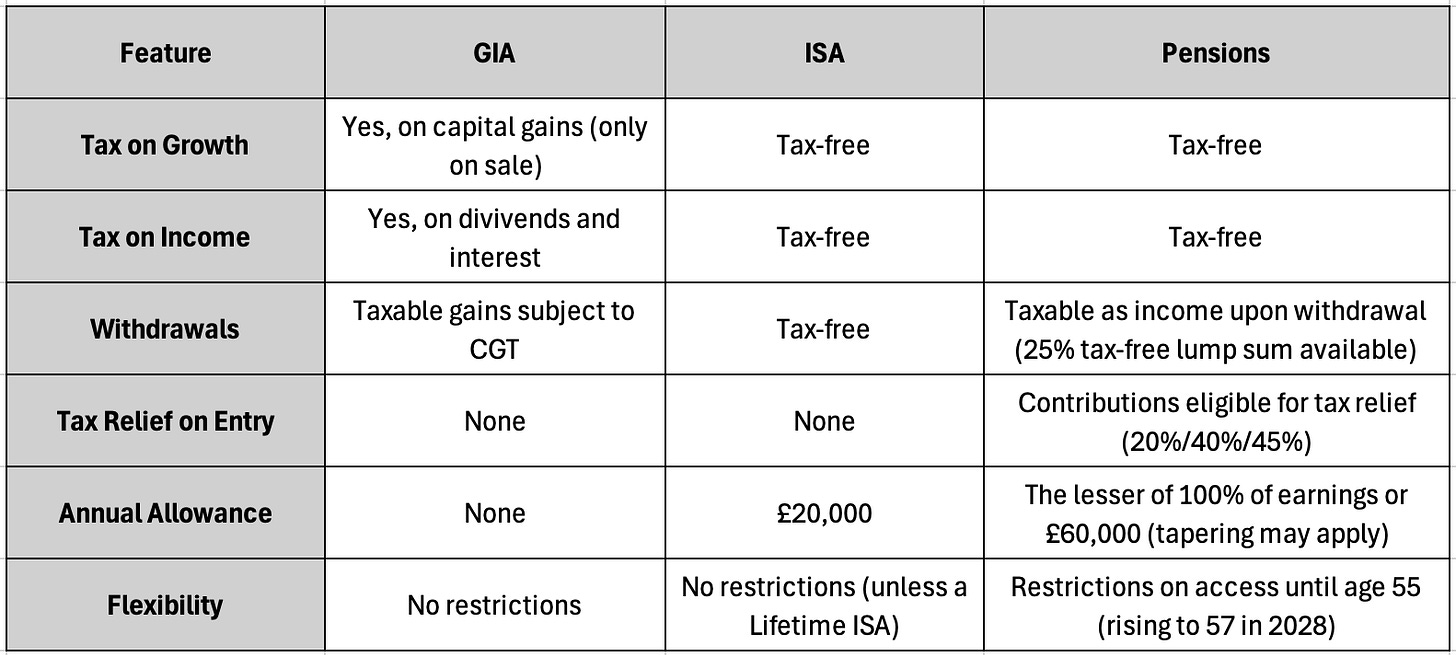
GIA = General Investment Account
For instance, a higher-rate taxpayer paying into a pension and receiving tax relief, compounded with market growth and no tax drag, can achieve significantly better long-term outcomes than investing in a GIA (which has no tax benefits).
By now you should be seeing that pensions are undeserving of their bad press. For many of us they really are the best vehicle for creating real wealth.
Comparison
To illustrate the point, let's look at an example. How does investing £80 per month in a pension compare to £80 outside of a pension?
The below graph is based on a 5% annual return for 25 years with three different investment scenarios:
- £80 a month invested into a Stocks & Shares ISA.
- £80 a month invested into a personal pension(basic rate relief only).
- £80 a month invested into a workplace pension(125% uplift).
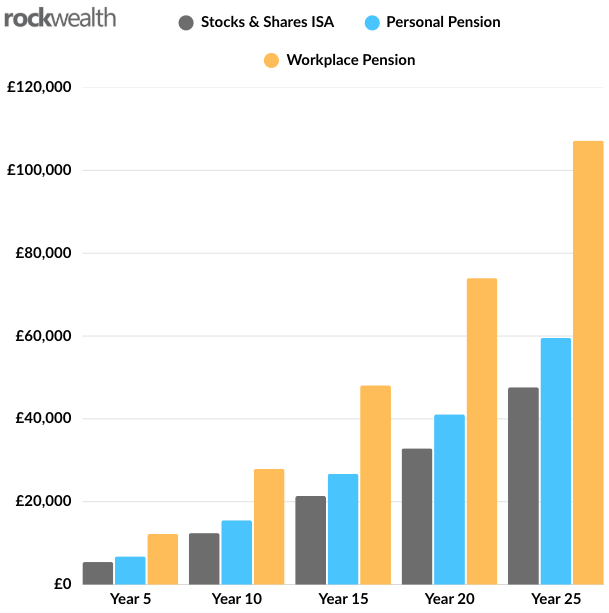
At no additional monthly cost to yourself, you could end up with a pot over 50% larger than if you were investing outside of a pension.
As covered in the next section, you’ll potentially have to pay some tax when withdrawing the funds within your pension; however, the additional growth coupled with strategic tax planning should result in a net positive position.
(ISAs are still a valuable tax-wrapper, as they’re accessible and the withdrawals are tax-free, making them a great companion to a pension).
Flexible Income Options
Once you reach the minimum pension age (currently 55, rising to 57 from April 2028), you can access your funds in several ways.
Before we look into them, lets quickly bust some jargon:
- Uncrystallised Funds (also know as an accrual pension):This is pension money you haven’t accessed yet. It remains fully invested and growing, and you haven’t taken any tax-free cash or income from it.
- Crystallised Funds (also know as a drawdown pension):This refers to pension money you’ve accessed. You’ve either taken your 25% tax-free cash, moved it into drawdown for income, or bought an annuity. It’s now subject to pension income rules.
OK, lets now look at the main ways you can access your DC pensions for income:
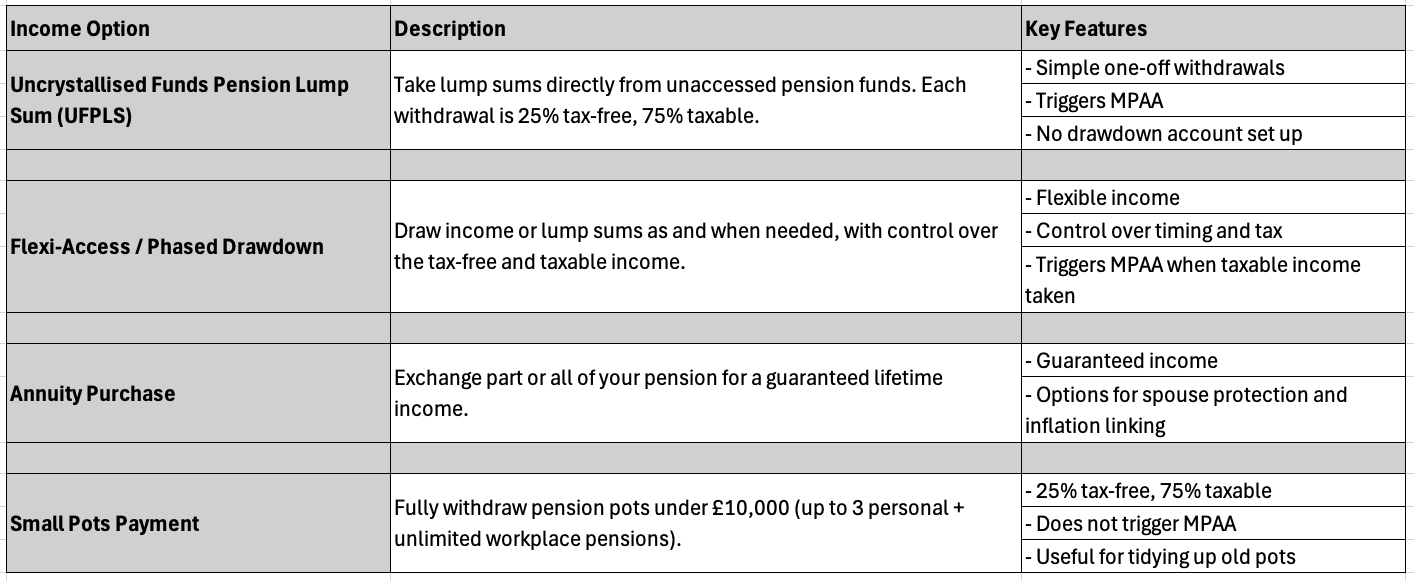
If you flexibly access your pension (e.g. draw income under flexi-access drawdown or take a UFPLS), your annual contribution limit drops from £60,000 to just £10,000 (the MPAA).
The best option depends on your needs, age, health, and broader financial situation. There is no universally ‘best’ route - only the one that’s most aligned with your needs.
Pensions offer unmatched flexibility to structure retirement income tax-efficiently. By blending pension withdrawals with ISA income or GIA capital gains, tax thresholds can be optimised.
A note on functionality
Not all pensions are created equally. In fact, there can be a wide gap in the functionality of some pensions compared to others. Some pensions only offer limited income options, whilst others provide full control and flexibility.
Here’s a real life example from one of our clients before we began working together:
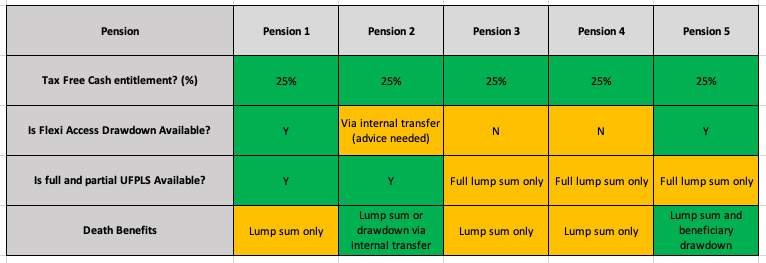
Their existing functionality was limited and unsuitable to meet their retirement income needs.
This isn’t important when you are still years away from retirement; however, the functionality - or lack there of - of your pensions becomes crucial as you begin to plan your retirement.
Technical Details
Pensions are complex, there’s no way around it. Regulations and tax implications are forever changing. Retirement planning is like setting off on a journey but the map keeps getting updated along the way - a key part of the work we do is help our clients navigate this ever changing landscape.
The below are some important technical points, which are correct for the 25/26 tax year:
Annual AllowanceYou can contribute up to 100% of your UK relevant earnings each tax year, capped at a £60,000 annual allowance. This includes both personal and employer contributions - exceeding this may trigger a tax charge.
Tapered Annual AllowanceFor high earners, the allowance reduces gradually from £60,000 to £10,000 where adjusted income exceeds £260,000. This tapering requires close monitoring for directors and professionals with high incomes.
Carry ForwardUnused allowance from the previous three tax years can be carried forward - potentially allowing contributions of up to £240,000 in one go, if earnings permit and you were a pension scheme member in those years (even if you weren’t contributing).
Money Purchase Annual Allowance (MPAA)If you flexibly access your pension (e.g. drawdown or UFPLS), your annual allowance for DC pensions reduces to £10,000, and carry forward cannot be used.
Inheritance Tax (IHT)Currently, pensions sit outside your estate for IHT purposes. However, from 6 April 2027, tax-free treatment on death may be replaced by IHT on lump sums (exact rules pending). This makes careful beneficiary nomination and drawdown planning even more important.
Pension Consolidation
Many individuals accumulate multiple pension pots over the years. This fragmentation can cause:
- Poor visibility of overall investment strategy
- Higher combined charges
- Outdated or underperforming fund selections
- Misaligned beneficiary nominations
- Limited or unsuitable functionality at retirement/on death
Consolidation (where appropriate) offers benefits such as:
- Simplified tracking and reporting
- Alignment with your risk tolerance and objectives
- Reduced costs and increased transparency
- Improved functionality and death benefits
Caution: Some pensions have valuable guarantees (e.g., guaranteed annuity rates, protected tax-free cash, or enhanced lifetime allowance protection). These must be assessed carefully before moving any funds.
How We Can Help
Here’re some of the ways we help our clients with their pensions and broader retirement income planning:
- Maximise contribution strategies (including carry forward).
- Optimise investment allocations across pension, ISA, and GIA wrappers.
- Use cashflow modelling to test different retirement scenarios.
- Plan sustainably around income, tax, and longevity risks.
- Help structure and guide legacy planning.
We bring clarity and structure - grounded in evidence - to ensure your pensions serve your values and vision for the future.
Next Steps: Take Control of Your Pension Planning
- Audit your pensions: Do you know what you hold, how much they cost, what functionality they have and who your beneficiaries are?
- Maximise contributions: Are you taking advantage of allowances, salary exchange, or company contributions?
- Align your investment strategy: Does your portfolio reflect your time horizon, risk tolerance, need for return and ethical preferences?
- Plan your withdrawals: Have you considered how and when you’ll access your pension income? And when you’ll need to?
- Review IHT strategy: How do your pensions fit into your legacy planning?
Final Thoughts
Pensions are not just a tax shelter or retirement pot. They are a powerful tool for creating wealth, providing flexible retirement income options, and supporting your wider planning and legacy goals.
With careful planning and expert guidance, pensions offer:
- Exceptional tax efficiency and growth potential.
- Flexible income in retirement and on death.
If you haven’t reviewed your pension strategy recently - or would like to understand how your pensions can better support your goals - reach out to our team at rockwealth.
Let’s make your pensions work harder for you and your family.
Thanks for reading.
The value of investments can go down in value as well as up, so you could get back less than you invest. It is therefore important that you understand the risks and commitments.
This isnot personal advice based on your circumstances.
All views are my own.