


Contrary to popular belief, earning well isn’t an automatic path to wealth.
For many high earners, it becomes a gilded cage: high income, expensive obligations, and a growing complexity - with a nagging sense that you should be further ahead than you are.
If you’re a professional earning over £100,000 - especially with bonuses and/or equity compensation (RSUs, stock options etc.) - this article is for you.
Because once your compensation gets more complex, money tends to start seeping away in three ways:
- Tax rules that work against you.
- Lifestyle expansion that absorbs every pay rise.
- Inertia, because complexity makes decisions feel harder than they need to be
This article will give you a simple framework to make sure your income actually turns into lasting wealth for you and your family.
The steps to taking control:
- Follow the money (where does your income go?).
- Create surplus income.
- Understand your compensation.
- Beware the minefield of high earnings (AKA, the UK tax environment).
- Pull your most important financial lever.
- Use this checklist to stay on track.
Step One: Follow The Money (where does your income go?)
Understand where your money is going.
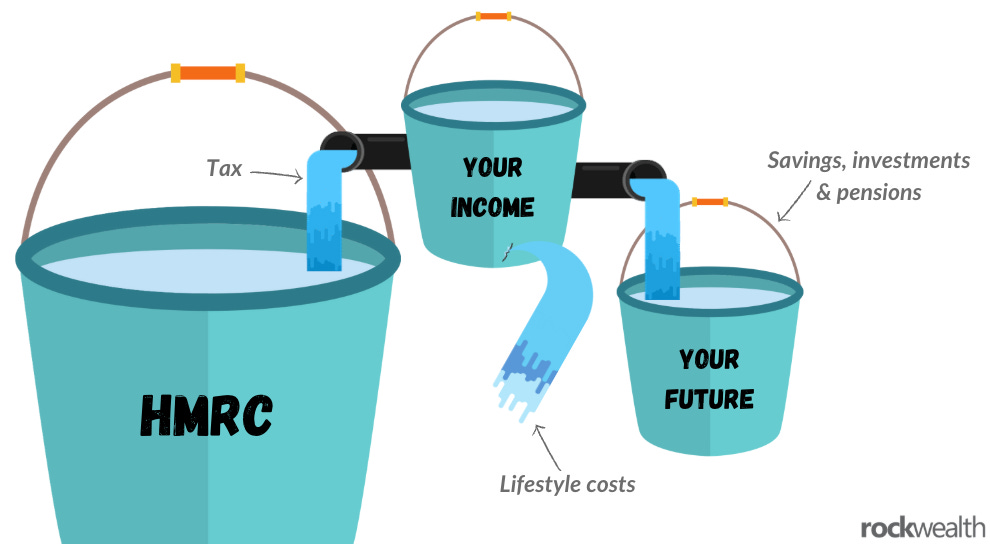
Broadly speaking, there are only three places your money can go:
- To HMRC (via tax)
- To other people and businesses (via spending)
- To your future-self (via saving and investing)
The name of the game is to:
- Legally reduce - where possible - what flows into HMRC’s bucket.
- Control your lifestyle spend so it doesn’t expand by default.
- Maximise what flows into your future bucket, because that’s what builds wealth.
Step Two: Create a Surplus Income
Spend less than you earn.
If you spend as much as you earn then you’ll never have a chance to build wealth.
Simple.
You need to create a surplus income, as this is raw material for building wealth which can be directed into investments within your ‘future bucket’.
Surplus income = net income − (essential spending + lifestyle spending)
For this step, you need to be conscious of lifestyle creep:
- nicer home.
- more expensive defaults (cars, holidays, schools, subscriptions).
- “we deserve it” spending that becomes the norm.
To be clear, there’s nothing wrong with enjoying your lifestyle - in fact, you should ensure you’re enjoying today whilst preparing for tomorrow; however, the risk is drifting into a lifestyle that consumes the very years when you could have built real wealth.
Step Three: Understand your compensation
Understand how you’re paid.
Once your income includes bonuses, equity and other perks, it’s not enough to simply know your base salary.
To plan properly, you need to know:
- What is taxed as income vs taxed as capital?
- When is the tax point, and
- How is the tax actually paid? (e.g., payroll, sell-to-cover, self-assessment)
You don’t need to become an expert but you do need to understand the what, when and the how.
Why?
Because this’ll determine whether a bonus or vesting event:
- pushes you into an unfavourable threshold, or
- becomes an opportunity to direct more funds into your ‘future bucket’
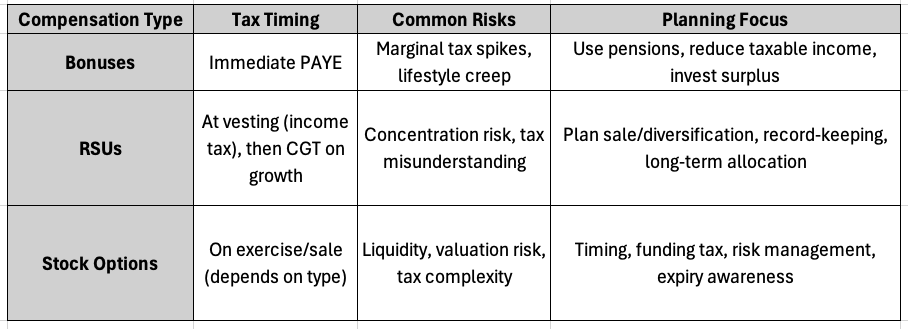
Here’s an example based on a typical compensation package you might see in Cambridgeshire at a science or tech company:
(Tax treatment depends on circumstances and can change. This is a generic example)
In this example, you’d need to know:
- When you’ll receive your bonus and whether sacrificing it into your pension is an option.
- When your RSUs vest (as the value will be taxed as income), and
- How that income tax liability will be covered (e.g. withheld units).
- When your stock options vest, as the value will be treated as part of your income for calculating certain tax thresholds.
- What tax you’ll pay on the resulting shares if/when you sell them.
All three of these compensation types could send you towards tax traps and a reduction in allowances - which we cover in the next section.
Step Four: Beware The Minefield of High Earnings
Understand your tax position.
In the UK, a lot of the tax problems arise on the middle portion of earnings, between £50,000 and £125,000, with other challenges presenting themselves once total earnings exceed £260,000.
Lets look at the main tax challenges you may face, allowing you to navigate the minefield with confidence.
Tax Traps
At a glance, our tax system appears simple enough for employees - we have four tax bands for earned income (seven if you live in Scotland), which are subject to income tax and national insurance (NI). As you earn more you progressively move through the tiers:
- 0% on the first £12,570 (£0 - £12,570).
- 28% on the next £37,700 (£12,571 - £50,270).
- 42% on the next £74,870 (£50,271 - £125,140).
- 47% thereafter (£125,141+).
(This doesn’t account for student loan repayments).
However, you begin to lose your personal allowance (the first £12,570 taxed at 0%) once your income exceeds £100,000, which means some/all of the £12,570 also gets taxed.
This is known as a ‘marginal rate tax trap’, as HMRC take 62p from every £1 you earn between £100,000 to £125,140 (it’s important to be aware of this as bonuses may push you into this area).
So, the tax bands actually look like this:
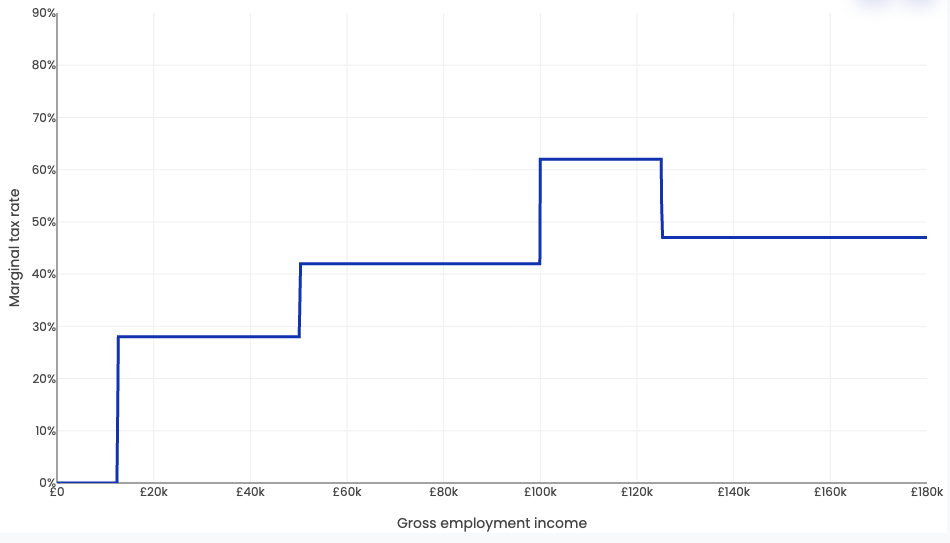
Source: Tax Policy Associates Interactive Calculator
Childcare and “effective marginal” cliff edges
For some families, the largest impact on their finances is the High Income Child Benefit Charge and the loss of free childcare hours - here’re the income thresholds to be aware of:
- £60,000+ (either partner/spouse): You’ll pay back 1% of your child benefit for every £200 you earn over the threshold, reducing to no child benefit after £80,000.
- £100,000+ (total household income): immediate loss of free childcare hours.
These can create eye-watering effective marginal rates and even lumpier tax tiers:
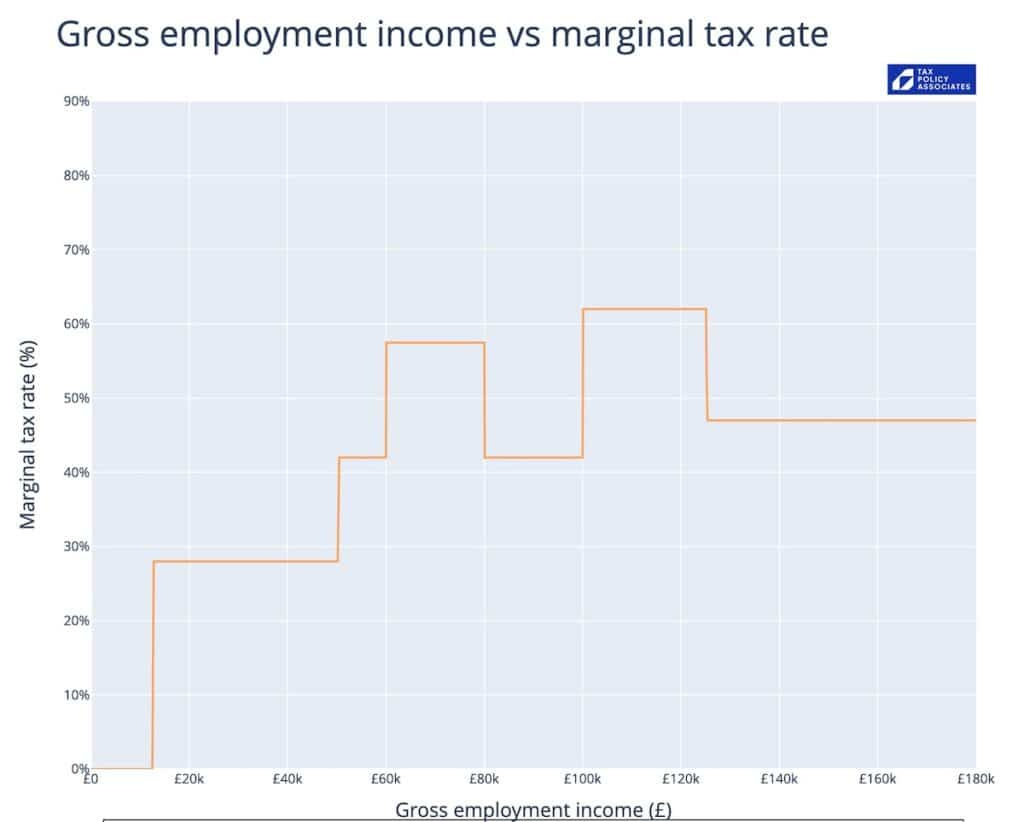
Source: Tax Policy Associates
If you’re close to a threshold, the outcome can change dramatically - so planning before pay events matters. On the other hand, when your income is way above these these thresholds, there’s nothing to be done.
Tapered Annual Allowance
Please note: this is complex, fiddly and, potentially, very important.
If your total remuneration is high you may have a lower cap than standard on the amount you can put into your pension without incurring a tax charge.
Here’s what you need to know:
- Annual Allowance (AA) = the amount you can put into your pension each tax year, currently set to a maximum of £60,000.
- The Taper = this reduces your AA by £1 for every £2 of adjusted income (explained below) over the £260,000 threshold, down to a minimum of £10,000.
At a high level, tapering only applies if both these tests are exceeded:
- Threshold income: broadly, your taxable income after certain reliefs/adjustments.
- Adjusted income: broadly, threshold income plus the value of employer pension contributions/pension input amount.
(This is a high-level summary, each calculation is more complex - detail here).
Here’s a decision-tree for the process:
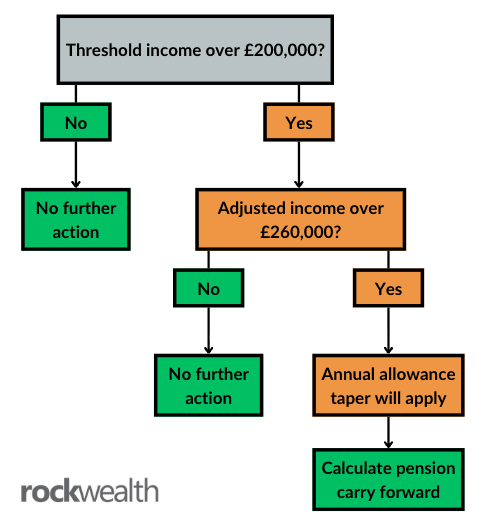
The calculations are complex and require a detailed understanding of your position - the same goes for the potential solution, which we cover in the next section.
If in doubt, seek advice.
Step Five: Pull Your Most Important Financial Lever
Pay attention to pensions.
For high earners, pensions aren’t just a retirement product, they’re a wealth creation machine and one of the most powerful tax-efficient tools at your disposal and could save you thousands of pounds in tax.
Here’s why…
Tax Relief
Personal pension contributions attract tax relief at your marginal rate:
- Basic rate: 20%
- Higher rate: 40%
- Additional rate: 45%
What does this mean?
It means the government adds money to your pension, which is referred to as ‘grossing up’ your contribution.
Here’s how it works on an £80 contribution (to get £100 into your pension):
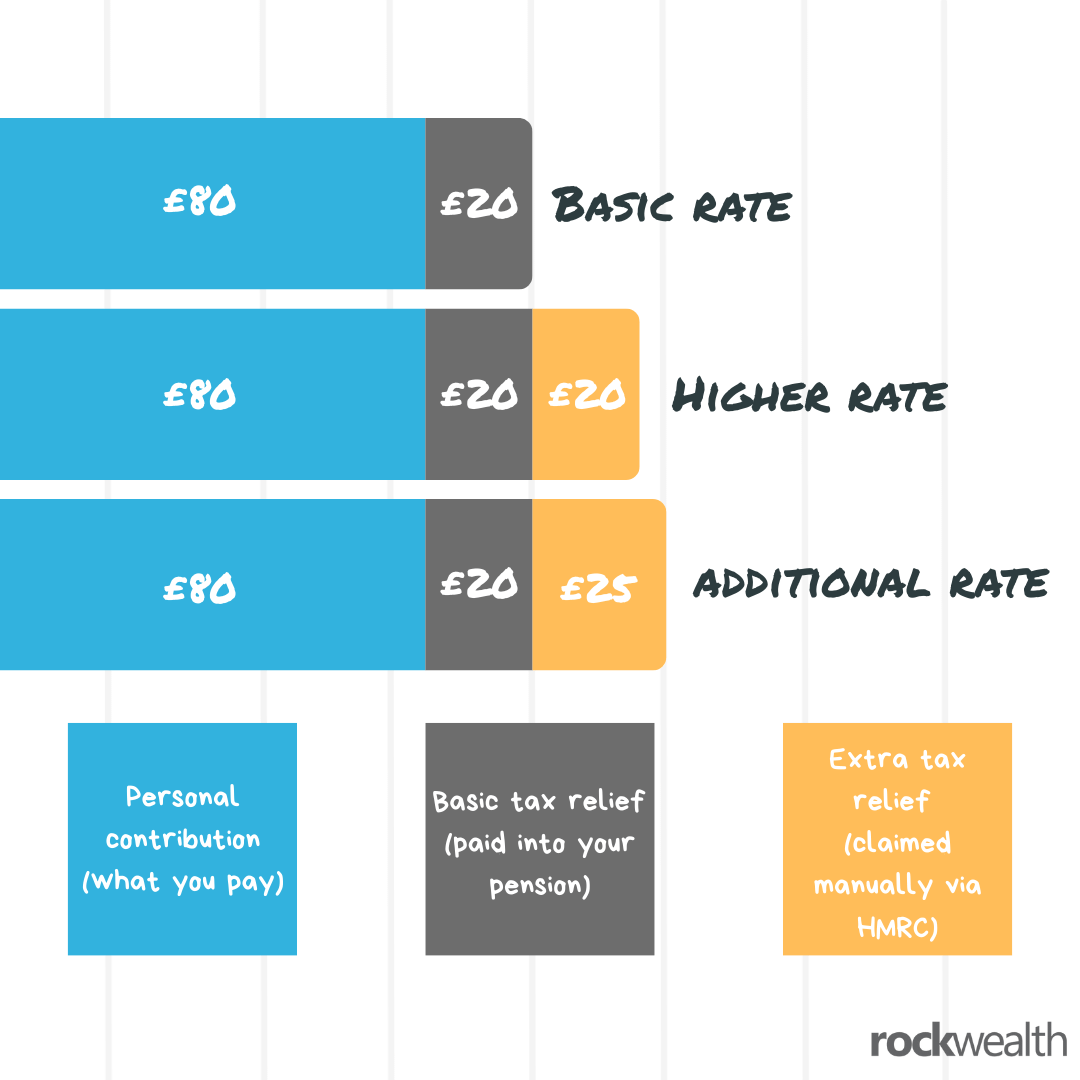
So, basic rate taxpayers only have to pay £80 of their own money to get £100 into their pension, as the government pays the other £20.
Whilst you - as a higher or additional rate taxpayer - can then reclaim a further 20-25%, via self-assessment, which is paid via one of the following:
- A tax rebate.
- A change in your tax code.
- A reduction in your tax bill.
The result of which is the net cost to get £100 into your pension is:
- Higher rate taxpayer: £60
- Additional rate taxpayer: £55
Lets look at an example:
- You’re an additional rate taxpayer and have just had £10,000 of RSUs vest.
- As the vested value is counted as income - and taxed accordingly - you receive £5,300 of shares after your employer withheld sufficient units to cover the tax bill.
- You immediately sell the shares prior to making a chargeable gain.
- You decide to put the £5,300 net proceeds into your pension.
HMRC will add 20% tax relief to the contribution, ‘grossing it up’ to £6,625 and you can reclaim another 25% via self-assessment (£1,656):
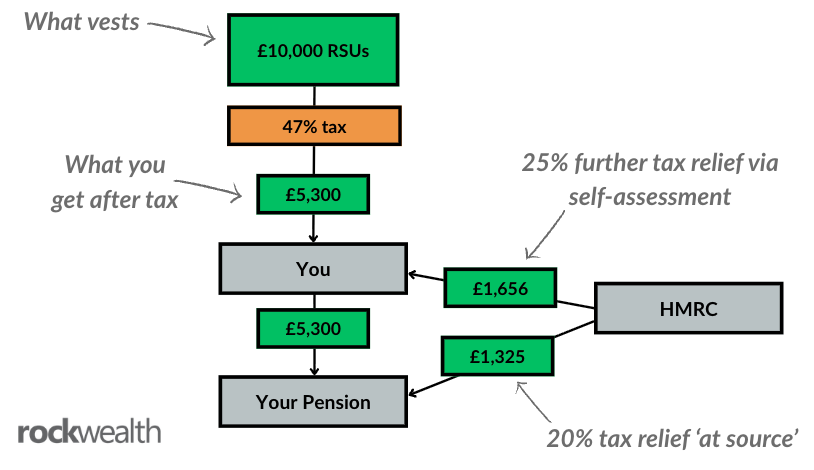
Net result: £6,625 in your pension + £1,656 tax relief = £8,281
So, by utilising a pension, you’ve reduced a 47% tax bill down to a 17.19% marginal rate of tax - as you’ve only ‘lost’ £1,719 to HMRC.
Salary Exchange (AKA, Salary Sacrifice)
As the name suggests, this is when you agree to exchange part of your salary for a pension contribution - this is done via a contractual agreement between you and your employer.
What’s the benefit?
The portion of the salary you exchange goes in before income tax and national insurance, which makes it a brilliant planning opportunity - especially for bonuses.
Lets look at an example:
- Your the sole earner in your household and make £100,000.
- Your family benefits from free childcare hours.
- Your employer wants to give you a bonus of £10,000.
On first glance, the £10,000 probably sounds great - after all, who doesn’t appreciate an extra £10k?
Well, in this case it’s very much not appreciated.
Why?
- You lose 100% of the free childcare when household income goes a penny over £100,000.
- And, you begin to lose your Personal Allowance over £100k earnings; so, the bonus will be subject to 62% tax.
The net result = you only keep 38p of every £1 from the bonus (£3,800) and lose potentially thousands of pounds worth of free childcare.
(If you’ve seen stories in the news about people intentionally earning less, this situation is often why).
Now, if your employer is kind enough to let you redirect that bonus into your pension your net result is much better:
- You have £10k invested tax-efficiently for your future.
- And, you retain your free childcare hours.
(Under current rules, from 2029 any salary exchange - after the first £2,000 - will be subject to National Insurance and only avoid income tax).
Pension Carry Forward
Carry forward = the ability to utilise unused Annual Allowance (AA) from three previous tax years, after you’ve maxed out the current year’s allowance.
Carry forward is a great way to shovel a lot of money into your pension in one go - up to £240,000 in some cases.
Here’s how it works:
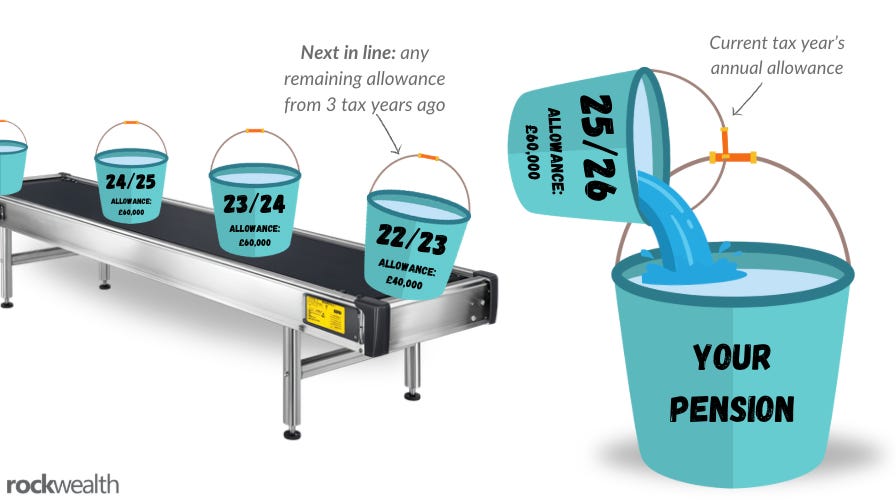
You utilise this tax year’s allowance first, then the one from three years ago, then two, then one.
This is particularly handy if you have a large bonus inbound and not much AA left.
In practice, this is a complex affair to calculate - as you need to know:
- Your total pension contributions in each tax year.
- Whether your AA was tapered in any of the previous three tax years (and, therefore, the threshold and adjusted income for each tax year).
Lets look at a real life example from a Cambridgeshire client working in tech (with an adjusted income over £260,000), who wanted to put a portion of their bonus into their pension:
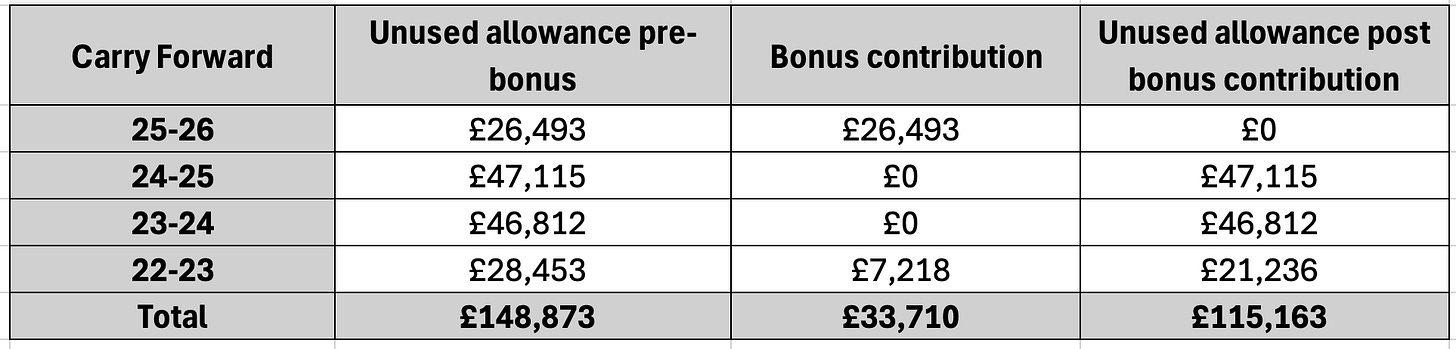
Due to existing pension contributions and being subject to the AA taper, they didn’t have sufficient allowance left in the 25/26 tax year to cover the full value of the bonus contribution; however, after doing the necessary calculations we were able to confirm they had sufficient carry forward to proceed with the contribution.
Without carry forward, the client would’ve received 53% of the £7,218 in their pay and they wouldn’t be aware of their options in future tax years for further additional contributions amounting to over £90k.
A note on pensions
Whilst pensions are a great planning and wealth creation tool, it’s important to note that, under current rules, any money you put into a pension can’t be accessed until your mid-to-late 50’s.
So, whilst the ‘spreadsheet answer’ will usually be to put everything you can into your pension, you need to balance this with your real world need for liquidity.
General Investment Accounts (GIAs) and Stocks & Shares ISAs become a valuable tool for investing when shorter term access to investments may be required.
Questions to ask yourself
- Will equity vesting and/or bonuses push me into tapered AA territory (or deeper into it)?
- What is my AA position this year and what carry forward is actually available given prior-year tapering and contributions?
Once you know the answers, you can make informed decisions about how much you can fund into pensions without surprises.
Step Six: Use This Checklist to Stay on Track
Keeping on top of it.
Financial planning isn’t a one-time event, it’s an ongoing process which often requires touch points throughout the year.
Here’s a checklist to help you take control of your high income:
- Know your compensation: salary, expected bonus and vesting/option events.
- Monitor your earnings against key thresholds -think £100k, £200k, £260k.
- Decide what you want to do with each bonus/vesting before it arrives.
- Maintain records on your pension carry forward.
- Leverage your pension, where appropriate.
- Create, maintain and invest surplus income for your future.
- Stay informed on the ever-changing regulatory and tax landscape.
Final thought
High earnings should make your life easier, not more complicated.
But without a framework - without understanding where your money goes and making intentional decisions about it - complexity wins.
The six steps in this article give you that framework:
- Follow the money
- Create surplus income
- Understand your compensation
- Navigate the tax minefield
- Pull the right pension levers
- Stay on track
Master these, and you’ll convert your high income into lasting wealth and genuine financial freedom.
You’ve worked hard to earn it.
Now make it work for you.
At rockwealth Cambridge, we help successful professionals in Cambridge gain clarity on complex compensation and turn high earnings into financial independence.
If you’d like to explore what strategic planning could look like for your situation, get in touch for an initial conversation.