


Inheritance Tax (IHT) tends to provoke a strong reaction - even from those unlikely to ever pay it.
It is a widely misunderstood tax, with many believing it touches everyone ; however, only a minority of estates (5-10%) actually pay any IHT.
For those it does affect, however, the numbers can be significant, making the planning decisions important.
This article sets out a clear, practical way to think about IHT:
- What it is (and who it affects)
- Why the rules are changing
- How to approach decisions sensibly
- The main planning options available
- And, importantly, what really matters beyond the tax itself
What Is Inheritance Tax?
In simple terms, IHT is typically charged at 40% on the value of an estate above available allowances.
For a married couple or civil partners, this often means up to £1 million can be passed on free of IHT, assuming full use of the nil-rate band and residence nil-rate band:
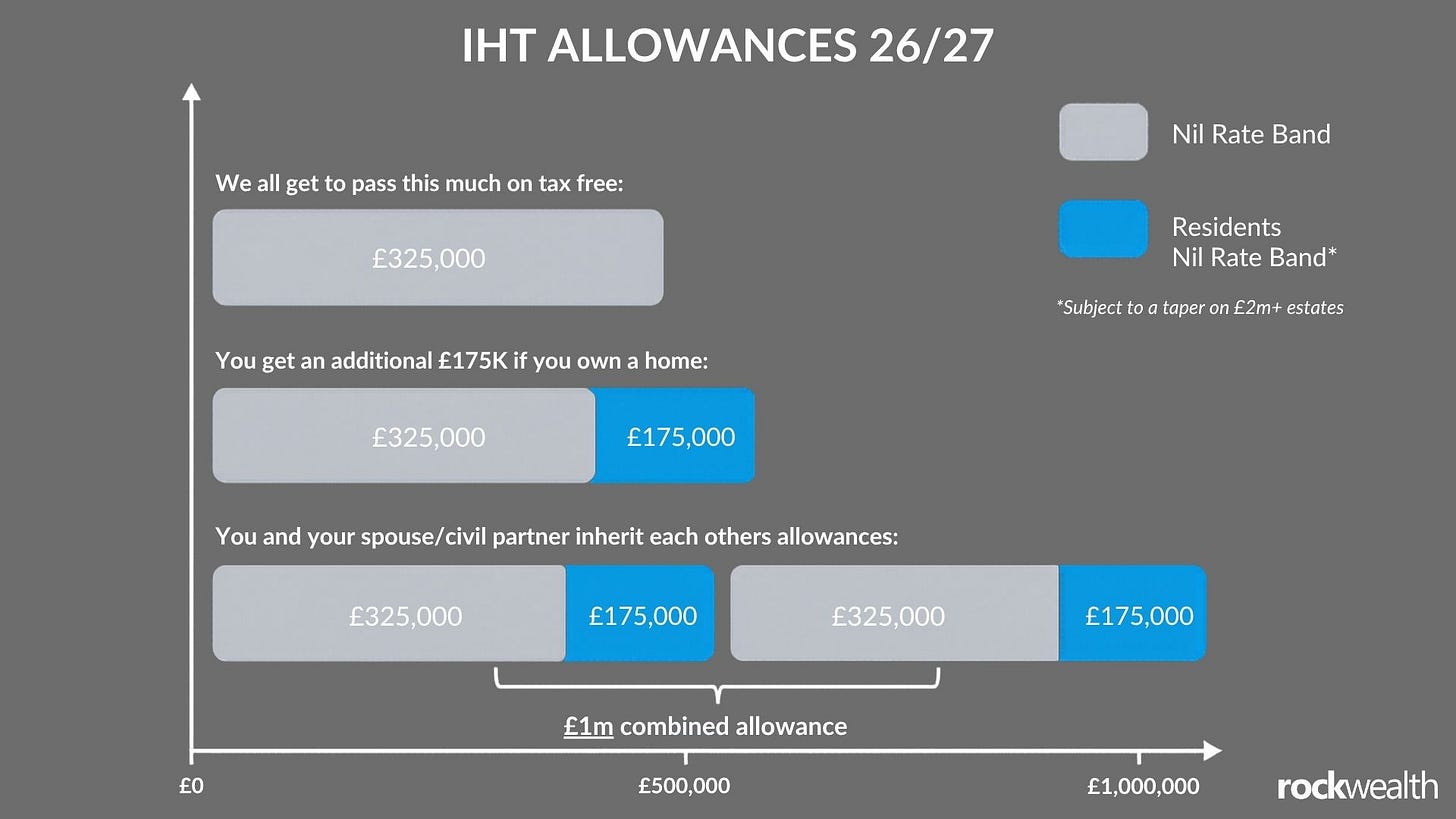
This is why many people don’t need to worry about it.
However, for those with larger estates - particularly in areas like Cambridgeshire where property values are high - IHT can become a material consideration.
The Rules Are Changing
One of the realities of financial planning is that tax rules don’t stand still.
A significant change being the proposed inclusion of personal pensions within estates for IHT purposes from 2027 - which will result in more estate’s having an IHT ‘problem’.
For example, a client couple I work with have most of their wealth in their pensions, which means their estate’s projected IHT exposure is set to increase substantially:
- Pre-2027: £77,581 tax bill
- Post-2027: £648,660 tax bill
That’s an increase of 736%.
Which reinforces an important point:
Financial planning isn’t a one-off exercise, it requires ongoing review as the rules evolve.
Making Better Decisions: Start Simple
“Some decisions are consequential and irreversible or nearly irreversible – one-way doors – and these decisions must be made methodically, carefully, slowly, with great deliberation and consultation. If you walk through and don’t like what you see on the other side, you can’t get back to where you were before.
But most decisions aren’t like that – they are changeable, reversible – they’re two-way doors… you don’t have to live with the consequences for that long. You can reopen the door and go back throughs”.
-Jeff Bezos
When people first think about IHT, they often jump straight to complex solutions — particularly trusts.
In many cases, that’s too big a leap.
A helpful way to think about decisions is:
- Reversible decisions (two-day doors: flexible, lower risk).
- Irreversible decisions (one-way doors: permanent -or hard to unwind - and more complex).
Trusts typically fall into the second category. They can be appropriate, but they involve:
- Loss of access to capital
- Additional costs and administration
- Long-term commitment
Yes, a trust may be suitable for your needs - but first, take a step back and look at all the other options available to you.
As Jeff says:
“These decisions must be made methodically, carefully, slowly, with great deliberation and consultation”.
The mistake is starting with complexity.
A better approach is to begin with simpler, more flexible options, and only move to more complex strategies where there’s a clear benefit:
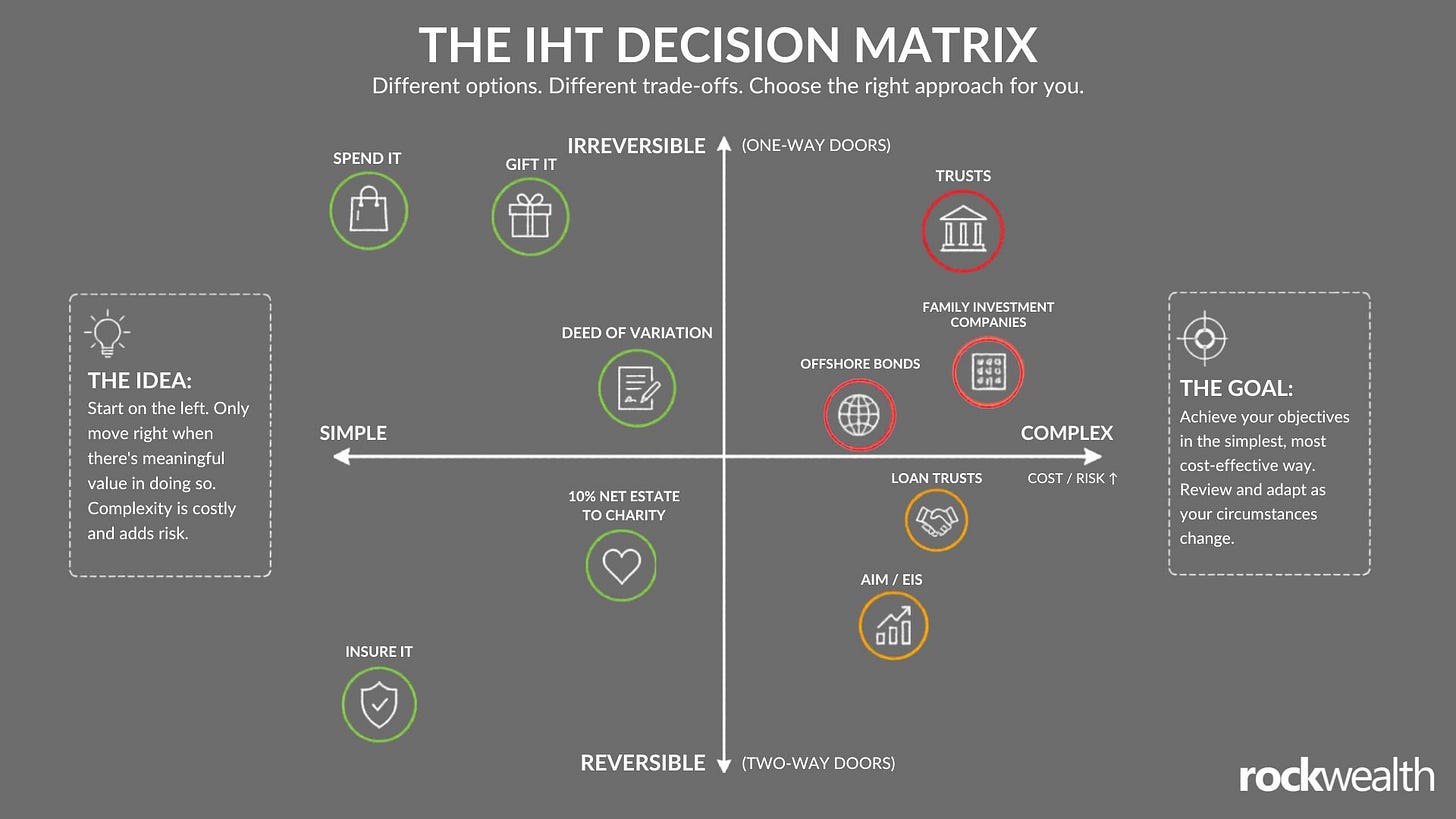
The Core Planning Options
- Insure it
- Spend it
- Gift it
- Structure it
- Put a ring on it
1. Insure It
It’s possible to use life insurance to cover an IHT liability.
Typically:
- A policy is written in trust.
- It pays out on second death.
- The proceeds are used to settle the tax bill.
When the surviving spouse passes away, the trust will pay out the proceeds directly to the executors to pay off the IHT liability.
The benefit of this is the executors don’t have to sell any of your assets to cover the bill.
The downside is you have to pay a monthly premium, so you’ll need to ensure it is affordable. If you stop paying the premiums, the cover will stop and there’ll likely be no cash-out value (some policies do carry an investment element).
For this option to work, you have to pay the insurance premiums for the rest of your lives.
2. Spend It
The simplest solution of all.
If your financial plan shows you have more than enough to meet your needs, spending more during your lifetime can:
- Improve your quality of life.
- Reduce the value of your estate.
- Lower a future IHT liability.
In practice, many people underspend because they’re unsure what’s sustainable.
Good financial planning provides clarity here - giving you confidence to enjoy your money without compromising your future security.
Intentionally spending your money on living a good life - whilst you’re fit and able to do so - has the added benefit of permanently removing said money from your estate, thereby reducing your IHT liability, ideal!
3. Gift It
On the face of it, gifting is one of the easiest ways to reduce an estate; however, it comes with emotional and practical considerations.
Common concerns include:
- Whether the money will be used wisely.
- The impact on family dynamics.
- Whether you might need the funds later.
These are valid concerns, there’s no one-size-fits-all answer and if you’re not comfortable giving away money, you probably shouldn’t do it.
However, it’s worth remembering a couple of things:
- You will die one day and your family will (likely) inherit your assets, and
- Gifts made during your lifetime can have far greater impact than those received later.
And here we reach the core of the gifting conversation.
“It’s better to give with a warm hand, rather than a cold heart”.
Which means, make gifts whilst you are alive (‘warm hand’) to see the benefits of them, rather than waiting until you’re dead (‘cold heart’).
In an ideal world, wouldn’t it be better to see your family/friends/chosen charities enjoy the fruits of your toil whilst you still have eyes to see?
Gifting should be a positive experience for you and everyone involved; however, working out the above points first is important to ensure it doesn’t backfire.
4. Structure It
Not all IHT planning is about giving money away or spending it.
In many cases, getting the structure right - how assets are owned, how they pass on death, and how your wishes are documented - can make a meaningful difference without introducing unnecessary complexity.
At a minimum, this means having the fundamentals in place:
- An up-to-date will that reflects your current wishes.
- Clear beneficiary nominations on pensions and protection policies.
- Consideration of how assets are owned (individually, jointly, or otherwise).
- Appropriate powers of attorney to ensure decisions can be made if you’re unable to do so.
These are often overlooked, but they form the foundation of effective planning, as without the right structure:
- Assets may not pass in line with your intentions.
- Opportunities to use allowances efficiently can be missed.
- Executors may face unnecessary complexity and delay.
- Unintended tax consequences can arise.
Good structuring doesn’t usually involve doing anything radical. It’s about making sure what you already have is set up properly.
5. Put a ring on it
This may not be the most romantic way to frame it but marriage carries significant tax advantages - particularly when it comes to IHT.
The key benefit is the spousal exemption (as shown earlier in the article).
If you’re not married (or in a civil partnership), the position is less tax efficient.
There is no spousal exemption, which means assets passed to a partner could be subject to 40% IHT. In practical terms, that can result in a tax charge on first death rather than second - reducing what your partner receives at exactly the point they may need financial security most.
In simplified terms, this could mean with a £1 million pound pension your:
- Wife would get £1m.
- Your unmarried partner would get £600k and HMRC would get £400k.
It’s also worth being clear: “common-law partner” has no legal standing in the UK. No matter how long you’ve been together, there is no automatic right to inherit, and no automatic protection from IHT without proper planning.
This isn’t to suggest marriage should be driven by tax. But it’s important to understand the implications. In simple terms, it can be the difference between assets passing intact or being significantly reduced by tax.
If you’re not married, make sure you have a clear, up-to-date will in place and that you fully understand how your estate would be treated. Assumptions in this area can be costly.
Don’t Lose Sight of What Matters
It’s all too easy to get caught up with IHT mitigation and only worry about how much of your hard-earned cash will be taxed after your die. Whilst it’s understandable to want to mitigate the tax bill, it’s important to not lose sight of what truly matters.
If your heirs have an IHT bill to settle on your estate then, in all likelihood, they’ll be OK - they’ll still be receiving significant assets from you.
Aside from the cold, hard cash, what will your legacy be?
Is there a greater gift you can give to your family than the unparalleled love and support of a parent?
It’s an invaluable gift that the government can’t touch or tax.
- You don’t need to put it in trust.
- You don’t have to rely on any tax allowances.
- You don’t have to do anything clever or complex.
You just have to provide it.
We’ll all be dust one day. So too will HMRC and all of our money. Real wealth is found in the quality of our relationships. Tax-efficiency and mitigation is important, but it isn’t everything.
With that said, onwards to some practical planning steps!
A Practical Starting Point
If you’re considering IHT planning, a structured approach helps:
Step 1: Secure Your Own Position
Before thinking about gifting or mitigation:
- Understand your assets, income, and expenditure.
- Define what “enough” looks like.
- Stress-test your plan.
- Ensure you can sustain your desired lifestyle.
Only once this is clear should you look at reducing your estate.
Step 2: Establish Whether There’s a Problem
- Is your estate likely to exceed available allowances?
- If so, by how much?
- Is the potential liability significant enough to act on?
Step 3: Choose the Right Approach
- Use the decision-making matrix and start with simple, flexible options.
- Only consider complex solutions where justified.
- Weigh costs against benefits carefully.
And importantly:
Keep the plan under review as circumstances and rules change.
The Cost of Doing Nothing
In some cases, doing nothing is a perfectly reasonable decision.
In others, the cost can be meaningful:
- A larger tax bill than necessary.
- Reduced flexibility later in life.
- Missed opportunities to support family earlier.
- Ongoing uncertainty.
Typically, the earlier planning begins, the more options are available.
Final Thoughts
Inheritance Tax planning isn’t about eliminating tax at all costs.
It’s about making informed, proportionate decisions that align with your wider financial plan and personal priorities.
In most cases, the right approach is:
- Start simple.
- Stay flexible.
- Focus on what matters most.
And ensure your planning evolves as your life - and the rules - inevitably change.
If you’d like to understand whether IHT is likely to affect you, and what (if anything) is worth doing about it, we’re always happy to have an initial conversation - you can get in touch here.