

From April 2027, pension pots will once again form part of the estate for inheritance tax (IHT) purposes. No tax is due on first death between married couples and civil partners; therefore, the issue typically arises on second death, when the money goes to the next generation/chosen beneficiaries.
What’s the main implication of this?
In short, many estates which currently have a low exposure to IHT could potentially find a much higher bill now awaits their beneficiaries. The government expects 10,500 estates to pay inheritance tax in 2027/28 that wouldn’t have before, and another 38,500 to pay more.
This change is likely to impact Cambridge-based households in particular, due to decades of strong property growth - with the average price of a detached Cambridge property sitting at £976,000 and the average semi-detached property sitting at £596,000 (ONS data).Adding the value of pensions on top of high property values, makes it almost inevitable that there’ll be a larger IHT bill on second death.
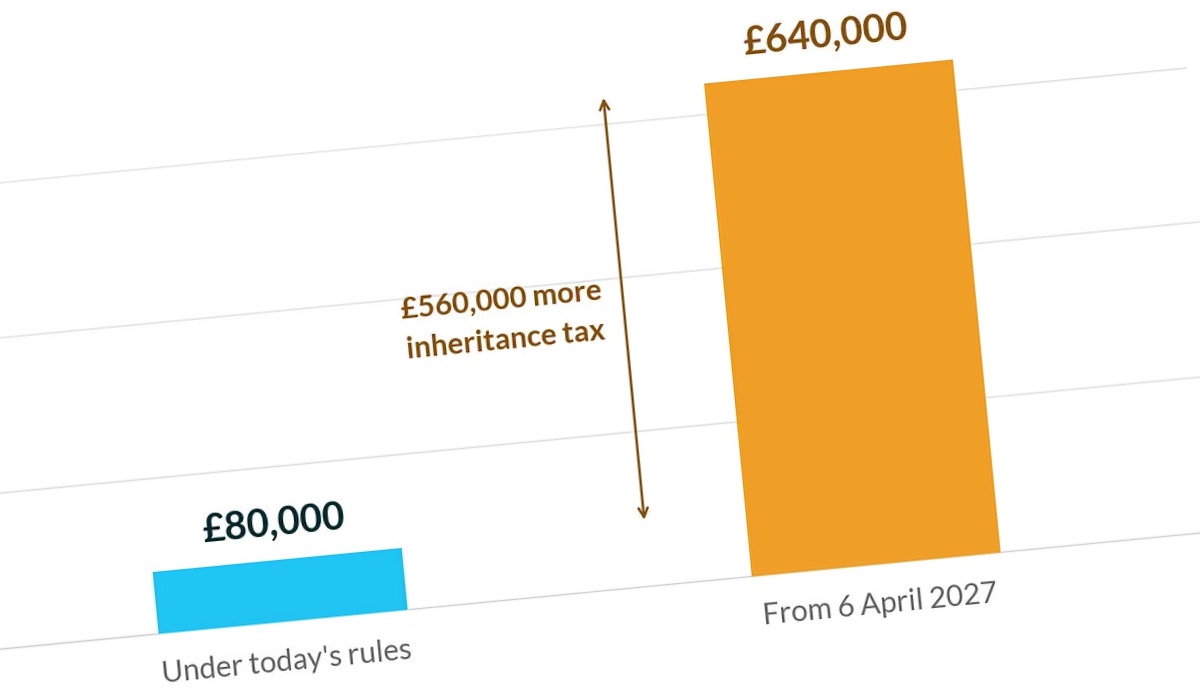
Here’s an example, based on a Cambridge-based client couple of mine (let’s call them John and Jane):
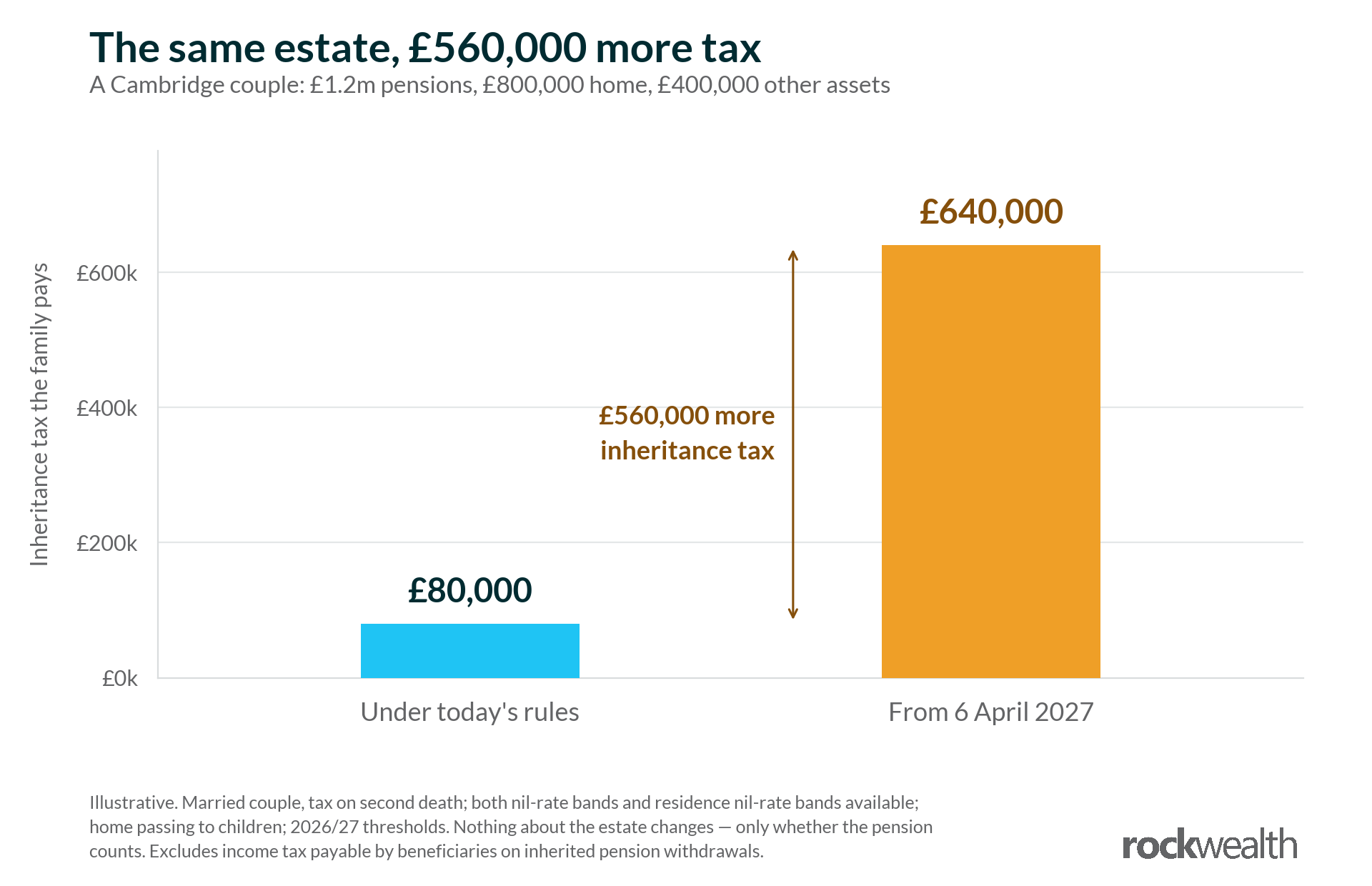
That’s a 700% increase in IHT liability from April 6th 2027.
So, if you have significant pension assets, there are a few planning considerations to take note of:
The 60% IHT Trap
Double Taxation
Unused Tax-Free Cash
How to Mitigate IHT
The 60% IHT Trap
Most people know the headline rate of IHT is 40%. A lesser known fact is that the loss of an allowance above £2m gives way to an effective rate of 60%.
The residence nil-rate band (RNRB) gives you up to £175,000 each when your home passes to children or grandchildren and the nil-rate band (NRB) is £325,000 each - which are passed between couples; therefore, most couples can pass on up to £1m IHT free.
However, once the value of an estate is over £2m, the RNRB tapers away by £1 for every £2 over - leading to the 60% IHT Trap, running from £2m to £2.7m for a couple, and £2m to £2.35m for one person:
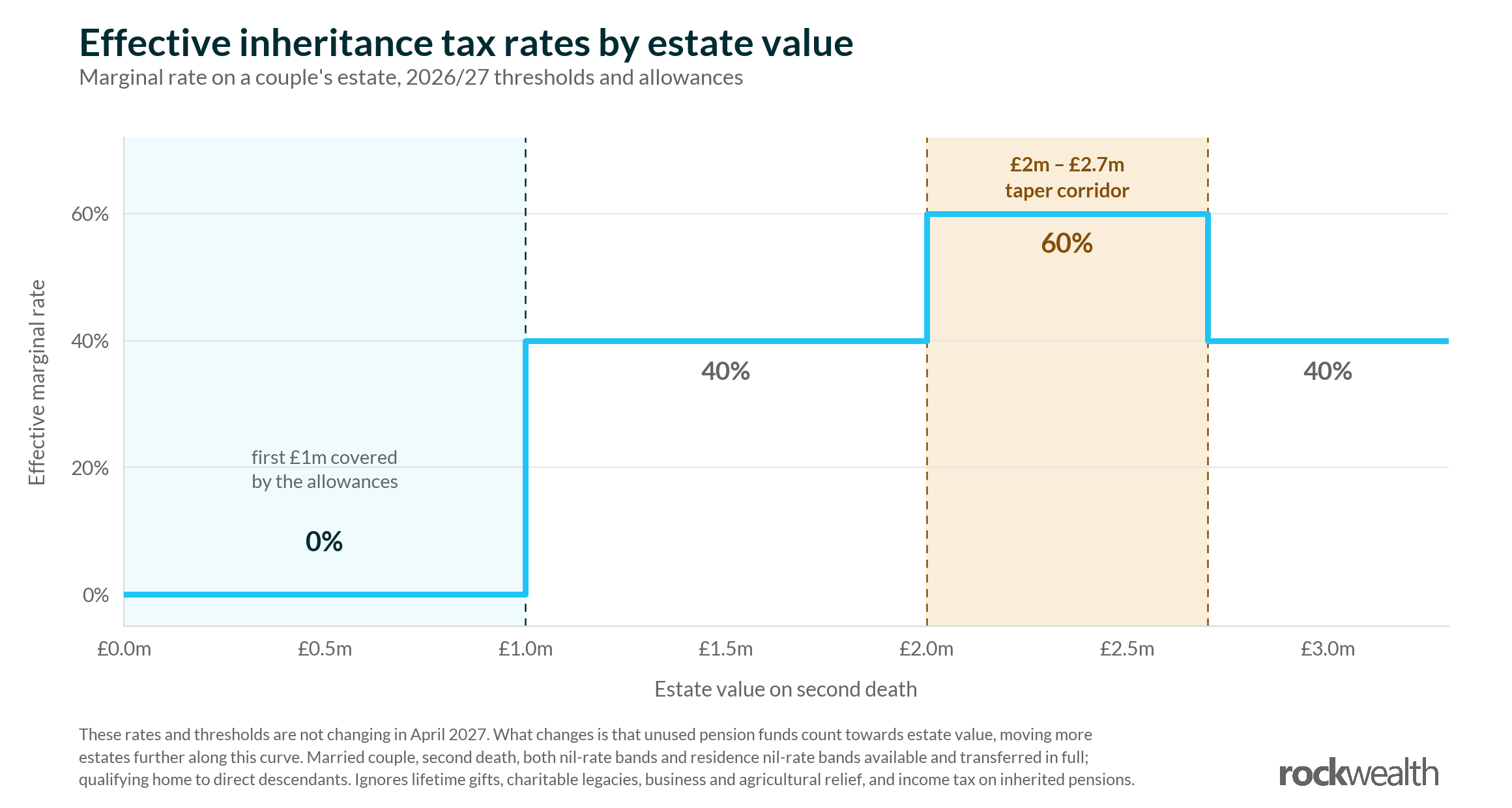
That’s 60p in every £1 going to HMRC within the taper corridor - this is why John and Jane have such a large increase in their tax bill from April 2027. Their estate value is currently £1,200,000, which means only £200,000 is currently subject to IHT. Once their £1.2m pensions are added into their estate, the value reaches £2.4m, leading to £1m being taxed at 40% (£400,000 IHT) and £400,000 at 60% (£240,000 IHT).
Double Taxation
As it stands, if you die before your 75th birthday, then your beneficiaries can draw income and/or capital from your pension tax-free for life. If you die at or after 75 with the money still in the pension, your children pay income tax at their marginal rate on every pound they draw.
From April 2027, HMRC may well have taken 40% of your pension pot before it’s inherited - leading to your beneficiaries then paying income tax on the residual pot:
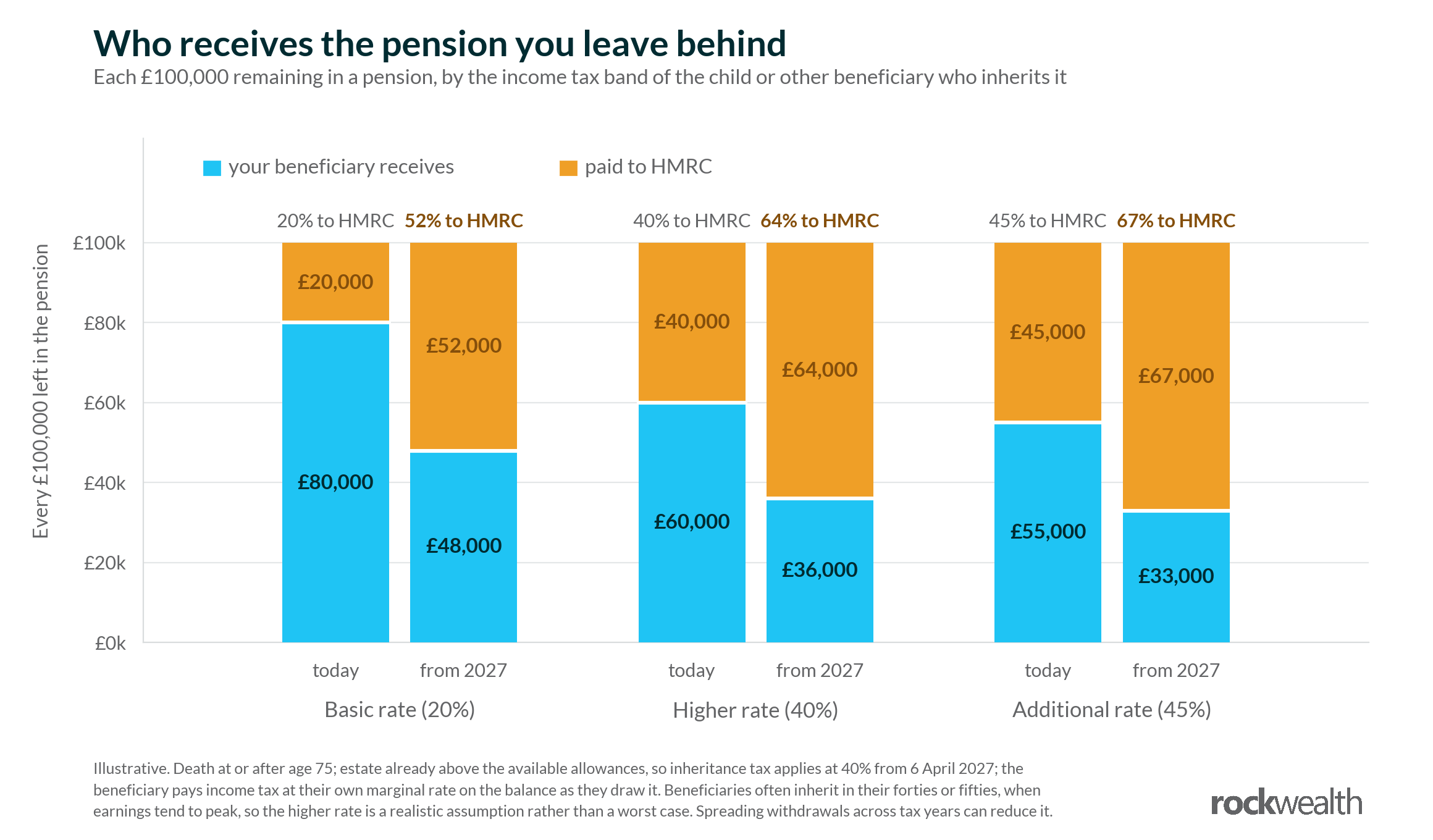
So, depending on how much your beneficiaries earn will determine how much the residual pension is taxed.
The Institute for Fiscal Studies estimates the average person inheriting “is in their fifties”, drifting towards the early sixties as parents live longer.
So, there’s a good chance your children will likely inherit your pension pot at the peak of their earning power, already paying 40%-45% on their salary (they don’t have to draw from the pension at this marginal rate, but it’s what they’d have to pay to gain access to the money if you passed away after age 75).
In practice, HMRC could end up receiving 60%+ of some pension pots via this double taxation.
Unused Tax-Free Cash
You can normally take 25% of your pension free of income tax, capped at £268,275. This entitlement is yours personally, and it dies with you. There’s no route for a spouse or beneficiary to claim any tax-free cash you never got round to taking.
Further to the previous section, if this tax-free cash isn’t taken, and you die post-age 75, then it could end up being taxed twice.
So, there are three main options for tax-free cash to consider:
Take it all before age 75, then spend it/gift it/enjoy it.
Take it all before age 75 and leave it within your estate (it could still be taxed at 40% but this removes the risk of double taxation).
Leave it in your pension post age 75 and run the risk your beneficiaries will be taxed twice on the money.
Here’s how it could look with £200,000 tax-free cash:
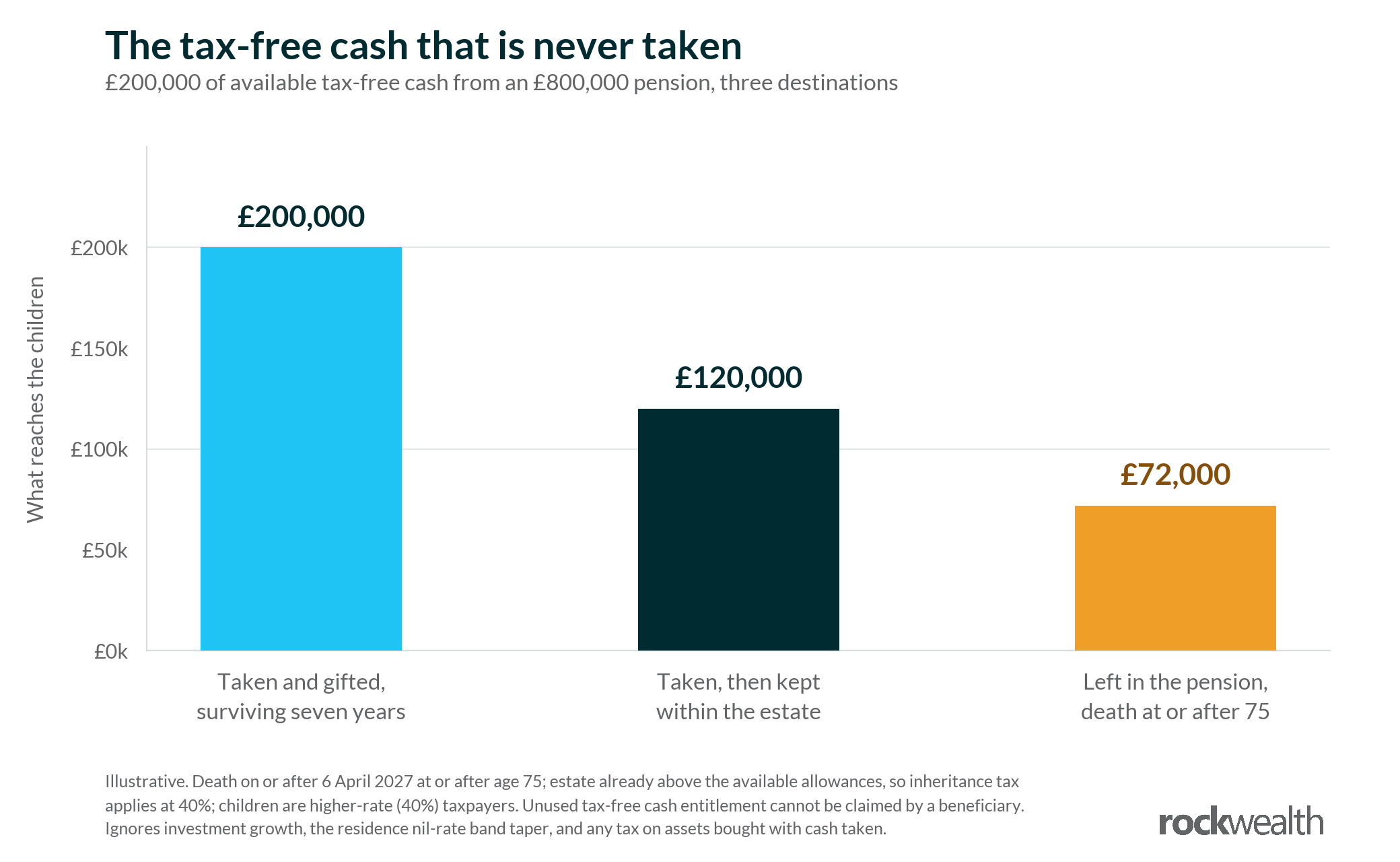
Ultimately, from April 2027, the tax system is incentivising you to take all of your tax-free cash before your 75th birthday and HMRC is the winner if you don’t.
How to Mitigate IHT
Quite simply, HMRC cannot (usually) tax money you don’t have.
So, if your estate has an IHT liability, the easiest way to reduce it is by spending, gifting and enjoying your money whilst you’re alive and able to see it being put to good use:
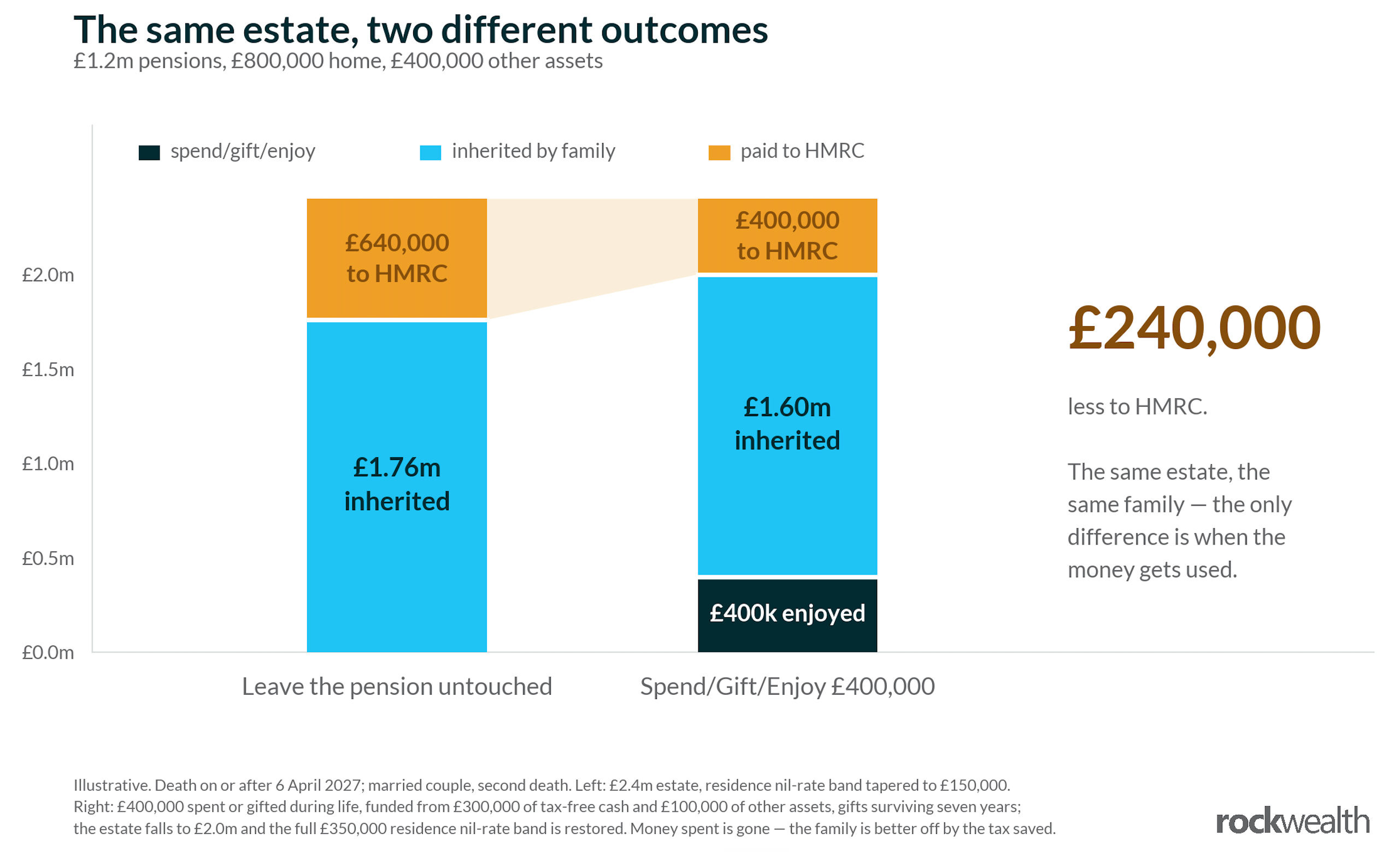
Utilising pension assets for your own retirement, rather than for estate planning, does invert what most people were told for the last decade.
Maybe take money from your pension and not only your ISA. Take the tax-free cash and do something with it. Give money to your children while you’re around to watch what they do with it.
Yes, more complicated options exist and they have their place, but they should only be considered after the simple options, not instead of them.
Whilst I do not personally agree with the overly punishing double taxation on pensions, I’m hopeful that the changes from 2027 will encourage more of my clients - who can afford to do so - to spend and enjoy their pension assets when they’re young and healthy enough to enjoy doing so. I call this having a Licence to Spend.
For more information on IHT planning, read our guide Warm Hands & Cold Hearts: A Practical Guide to Inheritance Tax Planning.
Thanks for reading,
Tom
Disclaimer: The figures in this article are illustrative. They assume a married couple, tax on second death, both nil-rate bands and residence nil-rate bands available and transferred in full, a qualifying home passing to direct descendants, and 2026/27 thresholds. The 60% figure is an effective rate created by the loss of the residence nil-rate band, not a statutory rate of inheritance tax. Your own position will differ.
The changes described here became law in Finance Act 2026 and apply to deaths on or after 6 April 2027. HMRC is still publishing guidance on how the rules will work in practice, including a further technical note this autumn on how inheritance tax and income tax interact. Some detail may change before April 2027, and tax rules and allowances can change at any time.
This article is for information only. It is not personal advice and it is not a recommendation to take any particular course of action. Pensions, tax and estate planning are complex and the right answer depends on your own circumstances. Take advice before you act.