
“In theory, there is no difference between practice and theory. In practice, there is.”
-Yogi Berra
When speaking with potential clients, we’re often asked two questions:
- What returns will you get me on my investments?
- How much income can I expect to receive in retirement?
Both are fair and sensible questions to ask a financial planner; however, in the first instance, our answer is, “it depends”.
It depends on you.
It depends on your health and longevity.
It depends on your circumstances, needs and wants.
It depends on your tolerance towards, understanding of, and capacity for, risk.
This is why retirement planning exists - to help provide peace of mind around what you can spend, and confidence that your plan can adapt when life changes.
Retirement Income Planning: An Art & A Science
Whilst retirement income planning may appear straightforward on the surface, in practice, it’s one of the most complex and nuanced areas of financial planning.
It involves making informed estimates about multiple variables: how long you’ll live, how markets will perform and how you’re likely to react, what inflation will do, and what life may throw at you along the way - this is where ‘the art’ comes in.
This article aims to help you understand both sides of the coin we’re working with when building financial plans for our clients in retirement:
- The Science: safe withdrawal strategies, ongoing research, long-term data sets, cashflow modelling, sequencing risk, and statistical probabilities.
- The Art: the human judgment required to adjust, adapt, and live fully through the complex, ever-evolving reality of retirement.
At rockwealth, our work centres around providing clients with peace of mind and financial clarity, which requires an ongoing mix of science and art.
The below is behind-the-scenes look at some of our considerations when building great retirement income plans for our clients - enjoy!
An Ever Changing Landscape
First, we need to set the scene.
Financial planning is like navigating with a map and compass, but the map is constantly evolving, the terrain keeps shifting, true north keeps moving and you’ll likely want to alter course along the way…
In the financial world, tax rules and regulations change over time, sometimes significantly, and these changes can materially affect long-term plans.
Alongside this, we face the unknowns of life itself.
None of us have a known expiry date and we don’t know what the future holds, if we did, planning would be much easier!
Due to this, the real value of financial planning lies in ongoing advice and informed decision-making over time.
The biggest risks in retirement rarely come from the original plan itself, but from decisions made later - often under stress, uncertainty, or emotion.
Our role is to help our clients successfully navigate through this fog of uncertainty throughout a (hopefully) multi-decade retirement.
Front-Loaded Spending
You’ve probably come across one of these two rules of thumb at some point:
- The 4% Rule
- The Rule of 25
The key limitation of both is that they assume retirement spending is linear.
In reality, it’s not.
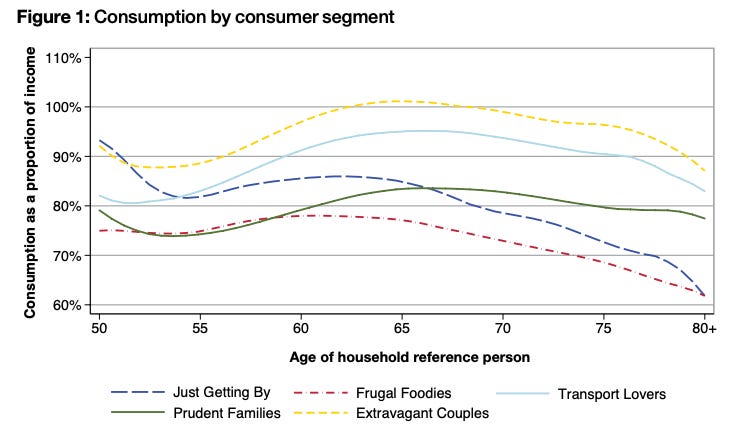
Spending typically tails off as you get older:
- In your 60s and early 70s, you may travel, pursue hobbies, and spend freely.
- In your mid-to-late 70s, spending typically slows.
- In your 80s and 90s, spending continues to decrease.
Research shows this pattern across different levels of wealth - most people spend less as they age, regardless of affluence:
Source: ILC
This matters because overly cautious assumptions can lead to overly restrictive plans. Many retirees won’t regret spending too much - they’re more likely to regret being too careful during the years when time, health, and opportunity were most aligned.
We often work with our clients on the basis of a front-loaded retirement plan: spending more during their active years, without compromising long-term sustainability of their assets.
Where Does Retirement Income Come From?
Retirement income usually comes from one of two places - and a retirement plan usually has a mix of both.
Understanding the difference between the two matters, because each behaves very differently over time.
1.Guaranteed income
Guaranteed income comes from sources that pay a regular, predictable income for life, regardless of what markets do.
Examples include the State Pension and defined benefit pensions.
These are often used to cover essential spending and provide peace of mind, because you know some income will continue no matter what.
The trade-off is removing flexibility for certainty.
Once income is secured this way, it’s usually difficult to change. Inflation protection may be limited, and guaranteed income doesn’t always match how spending actually works in retirement - especially in the earlier, more active years.
2. Productive Assets
Productive assets are assets that can generate income and/or growth over time, most commonly through rental properties or investment portfolios (typically a mix of bonds and stocks).
They don’t provide certainty year by year. However, we have decades of market data showing how diversified investments have behaved over the long term, through good times and bad.
This means planning is based on ranges of outcomes, not a single prediction. Income from productive assets is, therefore, guided by probabilities rather than guarantees.
The benefit of this uncertainty is flexibility.
These assets can support higher spending earlier in retirement and can be adjusted as life and markets change.
The risk is variability and no guarantee of an income for life.
Returns are uneven, so income needs to be reviewed and managed over time - particularly during market downturns.
The Reality
There isn’t one “right” solution. What matters is understanding where your income comes from, how each part behaves, and how they work together over a long retirement.
That understanding - combined with regular reviews - is what creates confidence and peace of mind over time.
Understanding the Risks
The key risk to retirement income are:
- Sequence of returns risk: Taking withdrawals during a market downturn early in retirement can deplete a portfolio faster than expected.
- Longevity risk: Living longer than expected means your money must stretch further.
- Inflation risk: Especially relevant today. Rising prices can erode purchasing power over time.
- Market risk: Investment returns can vary widely from year to year.
- Behavioural risk: The tendency to make emotional decisions - panic selling, over-saving, or underspending.
Good planning prepares for these risks in advance, building in buffers, stress tests, and scenario modelling.
The Power of Cashflow Modelling
Rather than rely on rules of thumb or averages, we use cashflow modelling to map how your income, spending, and assets might evolve over the course of retirement.
The model brings together key variables such as inflation, taxation, investment performance, spending patterns, and major life events. It allows us to explore different scenarios and understand how resilient a plan may be if things don’t go exactly as expected.
Importantly, cashflow modelling isn’t about predicting the future. It’s a decision-making tool that helps us see how changes - good or bad - could affect your plan, and what options may be available.
That’s where flexibility matters.
Retirement rarely follows a straight line. You might retire earlier or later, help family members, change your lifestyle, or face unexpected events. Markets will also move in ways no model can fully anticipate.
By reviewing and updating the plan regularly, we can adjust spending, withdrawals, and assumptions as reality unfolds. This flexibility helps manage risk, protect long-term sustainability, and support peace of mind - without needing to get everything “right” from day one.
The Human Element
Retirement is emotional.
It’s not just about numbers on a page.
It’s about your life, your relationships, freedom, and legacy.
Which is why the art of retirement income planning requires listening - understanding what matters to you and your family.
Our job is to help ensure your money is aligned with what’s important to you:
- What do you want your retirement to look like?
- Who do you want to spend it with?
- What experiences matter most?
These questions can’t be answered by a spreadsheet alone.
Conclusion: Planning for Life, Not Just Longevity
“There are no solutions, only trade-offs”.
Thomas Sowell
Retirement income planning sits at the intersection of certainty and uncertainty, precision and adaptability, spreadsheets and the real world.
It’s part science: using data, evidence, and modelling.
And part art: recognising that life isn’t linear, people aren’t predictable, and plans must evolve.
Done well, retirement income planning can deliver more than financial security - it can deliver confidence, freedom, and fulfilment. It allows you to spend with purpose, adjust with clarity, and live without fear.
At rockwealth, we help our clients build retirement plans that go far beyond withdrawal rates or product recommendations. We bring together strategic income modelling, ongoing advice, and empathetic support to ensure your plan supports the life you want to live.
Because a good retirement isn’t just about having enough - it’s about knowing what enough looks like, and how to make the most of it.
Thanks for reading,
Tom
Further reading on the subject:
If you want a deep dive and to learn more about the science of retirement income planning, I’d recommend the book, ‘Beyond the 4% Rule’, by Abraham Okusanya - which inspired this article.