At rockwealth, we help our clients achieve financial peace of mind - the kind that comes from knowing your financial future is secure, your loved ones are provided for, and you have the freedom to spend your time (and money) however you choose.
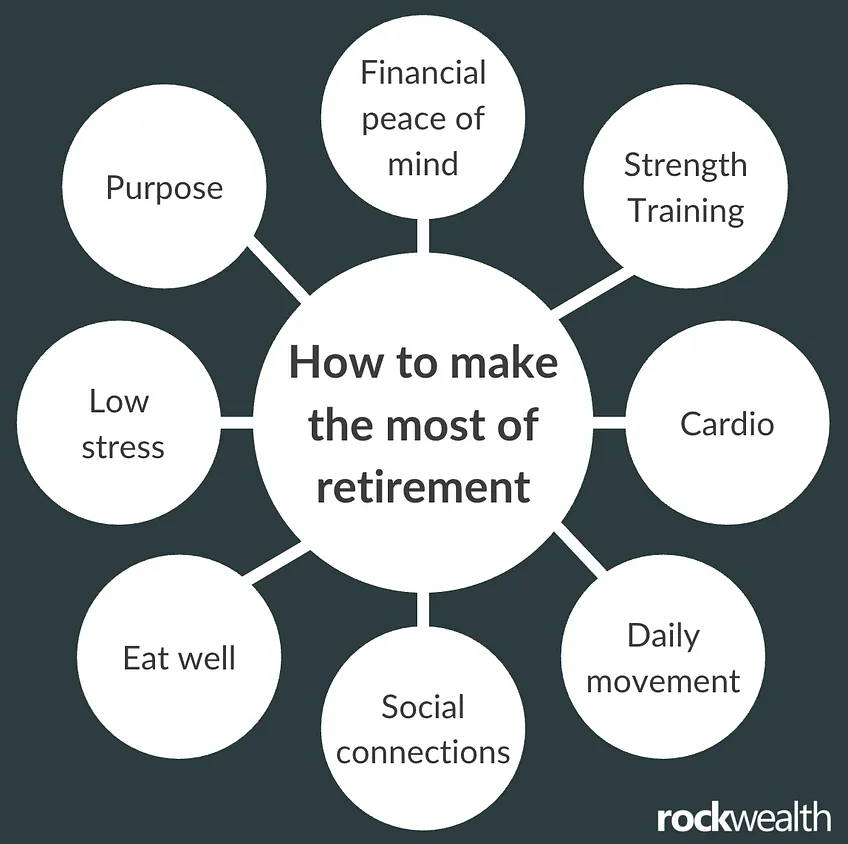
Our job is to help you build a financial plan that supports your desired lifestyle. But what if, when the time comes, your aren’t able to fully enjoy it due to your health? For many, their ‘golden years’don’t feel quite-so-golden. Too often, poor health, chronic conditions, and diminished energy prevent people from making the most of the time they’ve earned. While financial planning is important, when it comes to making the most of your retirement, we know it’s one piece of a larger ‘retirement puzzle’:

So, this guide is about the other ‘puzzle pieces’ which lead to a rich and rewarding retirement - predominately, relating to your health. Drawing on insights from longevity experts and research from the world’s healthiest populations, we’ll explore how small, intentional choices can improve not just how long you live, but how well you live. In this article, you’ll learn about:
- Why strength training is one of the most powerful tools for ageing well.
- How nutrition and cardio protect your body and brain.
- What the world’s longest-living people can teach us about lifestyle.
- How a personal trainer could be your best investment in retirement.
The Incentive: A Richer Retirement
“The most valuable asset you can possess in retirement is not a well-funded investment account. It’s a body and brain that still work.”– Dr. Peter Attia
Looking after your health gives you the freedom to enjoy your time, relationships, and passions - something money alone can’t do. Whether that’s:
- Playing on the floor with your grandchildren.
- Travelling with confidence.
- Staying mentally sharp for hobbies, volunteering, or family life.
Dr. Peter Attia, a leading longevity expert, calls this your “Centenarian Decathlon” - a set of basic, real-world physical tasks he believes we should train for now, so we can still do them in our 80’s and 90’s:
- Pick up a grandchild from the floor.
- Get up from the ground without using your hands.
- Carry shopping up stairs.
- Walk briskly for 30 minutes.
- Have the grip strength to catch yourself in a fall.
What You’re Up Against
Before looking at the solutions for a healthier retirement, we first need to identify some of the common causes which stop people from being able to make the most of their later years:
- Running out of health long before running out of life.
- The ‘Four Horsemen of Aging’.
- Muscle and bone atrophy.
Healthspan vs Lifespan
It’s one thing to live a long life, it’s another to live it well - this is the difference between lifespan (how long you live) and health-span (how long you live in good health). According to ONS data:
- The average man in England has a health-span of 62.4 years and a lifespan of 87.
- The average woman has a health-span of 62.7 years and a lifespan of 90.
Therefore, with the average UK retirement age at 65, many people spend most - if not all - of retirement in some state of diminished health:

The Four Horsemen of Aging
Dr. Attia defines the ‘Four Horsemen of Aging’ as:
- Heart disease.
- Cancer.
- Neurodegenerative disease (e.g. Alzheimer’s).
- Metabolic dysfunction (e.g. Type 2 diabetes, obesity).
These account for the vast majority of poor health and premature death and align with the UK data on premature mortality. While not all risks can be eliminated, many are modifiable through lifestyle changes.
Loss of Muscle Mass & Bone Density
If you’ve ever had an elderly relative injure themselves from a fall, these conditions were likely contributing factors:
- Sarcopenia = the loss of muscle mass and function.
- Osteoporosis = a condition of low bone mass and deteriorating bone quality.
These two conditions often coexist, which significantly increases the risk of falls, fractures, frailty, and reduced independence. Luckily, both can be managed through lifestyle interventions, which we’ll cover in the following section.
How to Improve Your Health-span
We are all a product of what we eat, think and do. As with financial planning and investing, improving your health comes down to evidence-based choices that sit within your control - which help to tilt the odds in your favour. So, lets have a look at some of the ways you can proactively improve your chances of a long and healthy retirement.
Lessons from the Blue Zones
“Blue Zones” are regions of the world with the highest concentrations of people living past 100 in good health. These include:
- Okinawa, Japan
- Sardinia, Italy
- Nicoya, Costa Rica
- Ikaria, Greece
- Loma Linda, California
Despite cultural differences, they share five common lifestyle habits:
- Natural movement: they move all day - walking, gardening, cooking, and playing.
- Strong social ties: Family, friends, and community are central.
- Plant-rich diets: Meals are simple, mostly whole foods, and eaten mindfully.
- Sense of purpose: They have a reason to get up in the morning (“ikigai” in Japan).
- Low chronic stress: Daily rituals (like prayer, naps, or walks) help them unwind.
Resistance (Strength) Training
“From the age of 30 to 60, we lose approximately 250g of muscle each year. After 70, this accelerates to around 15% per decade.” – NHS
Strength training is one of the most powerful tools for staying independent as you age. Loss of muscle (sarcopenia) and bone density (osteoporosis) increase the risk of falls, frailty, and loss of confidence. But this decline is not inevitable - it can be delayed or reversed with strength training, even in your 80s. Think of it as your ‘physical pension’: an investment in your future mobility, balance, and energy. Strength also supports brain health, better sleep, improved mood, and longer life expectancy. You don’t need to lift heavy weights or go to a gym - even light resistance at home can build strength over time.
Nutrition: Fuel the Life You Want
You don’t need a restrictive diet or perfect meal plan. But prioritising high-quality food - colourful vegetables, quality protein, healthy fats - supports energy, muscle retention, immune function, and cognitive health. If you’re fortunate enough to have financial freedom in retirement, spending intentionally on good food is a great investment for your wellbeing. Food is the fuel for our bodies. And, like an engine, the better the fuel, the better the performance.
Cardio: Protect Your Heart and Brain
“Exercise is medicine for the brain.”– Max Lugavere
Your aerobic fitness (your ‘engine’) is a key predictor of longevity and quality of life. Walking briskly for 30 minutes most days can:
- Improve cardiovascular health.
- Reduce blood pressure.
- Enhance mood and cognitive clarity.
- Lower your risk of chronic disease.
You don’t have to run marathons - just move often and aim to include some moderate intensity cardio into your week. Activities like cycling, dancing and hiking all count.
Hire a Personal Trainer (PT)
Hiring a personal trainer in retirement might be one of the best investments you ever make. Just as a financial planner helps grow and protect your wealth, a PT helps to build and preserve your physical capital - your strength, balance, and confidence. A good PT will tailor exercises to your needs, keep you safe, and help you stay consistent - leading to better results and lower risk of injury or illness. Strength training, with the help of a PT, will help you to live independently for as long as possible.
A Real-Life Inspiration
Still unsure whether it’s worth starting in your 60s, 70s or beyond? Watch: Rebuilding Mum & Dad – a powerful video by journalist Clare Johnston, who is helping her parents (alongside a PT) to transform their mobility, strength and energy with strength training in their 80s. Nine months ago, her mum could barely walk. Now she can walk briskl and unaided for six minutes. It’s never too late.
What This Means for Your Retirement Plan
Retirement planning means asking: how do I want to live? A robust financial plan ensures you have the resources, but your health determines how freely and fully you can enjoy them. Whether it’s hiking in your 60s or playing with great-grandchildren in your 80s, your physical wellbeing makes all the difference. Your money should enable that life. But so should your body.
- Good financial planning gives you the resources.
- Good health planning ensures you have the capacity to enjoy it.
Remember, spending money on your health and wellbeing is an investment not a cost - whilst your wealth allows you to live freely, your health allows you to live fully.
Final Thought
If you take one thing away from this article, let it be this:
- Invest in your health.
- Build your strength.
- Move your body.
- Don’t wait.
The goal isn’t to live forever - it’s to live well, for as long as you can:

Wishing you a long, healthy life, filled with activity, independence and joy. Thanks for reading.